

Table of Contents
- Artisan Bath and Body vs Lux Naturals: What Sets Them Apart?
- Quick Comparison: At a Glance
- Ingredients and Sourcing: Where the Real Difference Lies
- The Benefits of Cold Process Soap for Your Skin
- Fragrance and Essential Oil Profiles: Natural vs. Synthetic
- Lather, Texture, and Longevity: What to Expect from Artisan Bars
- How to Store Handmade Soap for Longevity
- Which One Should You Pick? A Decision Guide
- Frequently Asked Questions
Last Updated: September 5, 2026
Artisan bath and body products are defined by small-batch production, transparent ingredient lists, and the absence of harsh detergents, while commercial lines rely on synthetic fragrance blends and shelf-stabilizing additives. This comparison from Minerva Rae breaks down what separates a true artisan bar from a commercial alternative.
Cold process soap retains the natural glycerin produced during saponification, a humectant that draws moisture to the skin. Commercial soap makers often extract that glycerin to sell separately, leaving a bar that cleanses but does not moisturize.
Artisan Bath and Body vs Lux Naturals: What Sets Them Apart?
Artisan bath and body products are handcrafted in small batches using traditional techniques like cold process, where oils and lye cure slowly over several weeks. Commercial lines prioritize consistency and shelf life, using hotter processing, synthetic preservatives, and fragrance oils designed to smell identical batch after batch.
A cold process bar keeps its naturally occurring glycerin, which acts as a moisturizer. Many commercial bars remove that glycerin and replace it with synthetic detergents that strip the skin's natural oils. For anyone with dry or sensitive skin, that difference is noticeable within days.
Quick Comparison: At a Glance
| Feature | Artisan Cold Process | Commercial Bar Soap |
|---|---|---|
| Base Oils | Tallow, olive, coconut, shea | Palm oil, sodium tallowate |
| Glycerin | Retained naturally | Often extracted and sold |
| Fragrance | Essential oils, unscented options | Synthetic fragrance blends |
| Additives | Clays, oats, silk, botanicals | Preservatives, detergents, dyes |
| Production | Small-batch, hand-cut | Continuous, machine-molded |
| Skin Feel | Creamy, moisturizing | Can feel tight or stripped |
Ingredients and Sourcing: Where the Real Difference Lies
A handcrafted bar built on tallow, olive oil, coconut oil, and shea butter delivers a fatty acid profile that closely mirrors the skin's own sebum. These oils are chosen for how they behave on the skin, not for how cheaply they can be sourced in bulk.
Commercial soaps frequently rely on palm oil as a low-cost base. While palm oil is an effective cleanser, its production is linked to deforestation concerns, and it offers little in the way of skin barrier support. If you are choosing between an artisan bar and a commercial one, the ingredient list tells you most of what you need to know about how your skin will respond.
Comparative Ingredient Analysis Table
A deeper look at specific oil bases and additives reveals why artisan bars behave differently on the skin. The table below breaks down the most common ingredients in each category and what each one does.
| Ingredient | Artisan Cold Process | Commercial Bar Soap | Skin Function |
|---|---|---|---|
| Tallow | Primary base in many bars | Often processed into sodium tallowate | High in stearic and palmitic acids; creates a firm, long-lasting bar with a creamy lather that closely matches human sebum |
| Olive Oil | Common secondary oil | Rarely used | Rich in oleic acid; provides a mild, conditioning cleanse with a slick, low-foam lather |
| Coconut Oil | Used at 15-25% of the oil blend | Often present as sodium cocoate | Provides cleansing power and fluffy lather; too much strips skin, so artisan makers cap the percentage |
| Shea Butter | Added for superfatting | Occasionally added in tiny amounts | High in unsaponifiables (vitamins, phytosterols); deposits a moisturizing film on the skin |
| Castor Oil | Used at 5-10% | Rarely used | Boosts lather creaminess and stabilizes bubbles; also acts as a humectant |
| Palm Oil | Avoided by many artisan makers | Primary base in most commercial bars | Cheap source of palmitic acid for hardness; production is linked to deforestation and habitat loss |
| Glycerin | Retained naturally from saponification | Extracted and sold separately | Humectant that draws water into the stratum corneum; the single biggest reason artisan bars feel less stripping |
| Sodium Lauryl Sulfate (SLS) | Never present in true cold process | Common in syndet bars and melt-and-pour bases | Synthetic detergent that creates large bubbles but disrupts the skin barrier and can trigger irritation |
| Tetrasodium EDTA | Never used | Common chelating agent | Binds metal ions in hard water to prevent soap scum; unnecessary in a well-formulated bar |
| Synthetic Fragrance | Not used | Standard | Can contain phthalates and allergens; no therapeutic benefit |
A Closer Look at Ingredient Lists
A typical commercial bar lists "sodium tallowate, sodium cocoate, fragrance, tetrasodium EDTA" while a handcrafted bar lists "tallow, olive oil, goat milk, coconut oil, sodium hydroxide, castor oil." The artisan version names whole ingredients; the commercial version names their processed salts. That transparency is the first sign of a quality product.
In commercial bars, the first ingredient is usually the cheapest base oil, followed by water, then synthetic additives. In artisan bars, the first ingredient is typically the most nourishing oil, chosen for skin benefits rather than cost. If "fragrance" or "parfum" appears in the top five ingredients, that bar is not truly artisan-grade.
Artisan bars that use goat milk, like the Tallow & Goat Milk soap, add lactic acid and milk proteins that gently exfoliate and support the skin's moisture barrier. Commercial bars cannot use fresh milk because it spoils without preservatives, which is why you rarely see it in mass-market formulations.

The Benefits of Cold Process Soap for Your Skin
Cold process soap is made by mixing oils with sodium hydroxide (lye) at low temperatures, then curing for four to six weeks. During that cure, the lye fully saponifies and the bar hardens into a mild, moisturizing cleanser. The low heat preserves delicate oils like shea butter and castor oil.
Cold process soap offers two advantages for skin barrier health. First, retained glycerin pulls moisture into the outer layer of skin. Second, superfatting leaves a small percentage of unsaponified oils that deposit a light moisturizing film as you wash. This is why many people with winter-dry skin report that artisan bars soothe rather than strip.
Long-Term Skin Barrier Health: Beyond the First Wash
The more important question is what happens after weeks of daily use. The skin barrier, the outermost layer of the epidermis, is a complex matrix of lipids (ceramides, cholesterol, and free fatty acids) that keeps water in and irritants out. Every wash disrupts this barrier slightly; the question is whether your cleanser helps it recover or makes the damage worse.
Commercial detergent bars, especially those containing sodium lauryl sulfate, strip the skin of its natural lipid matrix (the FDA). Research consistently shows that SLS increases transepidermal water loss (TEWL), the rate at which moisture evaporates through the skin. When TEWL stays elevated over weeks, the barrier becomes compromised, creating a cycle: dry skin leads to micro-cracks, which allow irritants in, triggering inflammation that further weakens the barrier.
Cold process soap behaves differently because of three mechanisms:
-
Glycerin retention. Glycerin is a humectant that pulls water from the dermis into the stratum corneum. A single cold process bar contains roughly 5-10% naturally occurring glycerin by weight (peer-reviewed research). Commercial soap makers extract this glycerin and sell it to cosmetic companies, leaving a bar that cleanses without any humectant support.
-
Superfatting. Artisan makers deliberately use a slight excess of oils (typically 5-8%) that do not saponify. These unsaponified oils, often shea butter, jojoba, or avocado oil, remain in the finished bar and deposit a thin lipid film on the skin during washing. This film helps replenish barrier lipids rather than stripping them.
-
Mild pH profile. Freshly made cold process soap has a pH around 8-10, but after a full cure, most bars settle closer to 8-9 (peer-reviewed research). Commercial detergent bars often test higher due to alkaline builders. While neither matches the skin's natural pH of 4.5-5.5, the lower pH of cured artisan soap causes less barrier disruption than harsher alkaline detergents.
For people with compromised barriers, whether from eczema, over-exfoliation, or harsh cleansers, the switch to cold process soap can be part of a recovery routine. The key is choosing a bar with a high superfat percentage and minimal essential oils. Minerva Rae formulates bars like the Tallow & Goat Milk soap for sensitive skin, while the Old Fashioned Tallow & Oatmeal bar adds finely ground oatmeal for light exfoliation that calms irritation.

A common pattern is patients who blame soap for dry skin when the real culprit is detergent stripping their barrier daily. Switching to a glycerin-rich, superfatted bar addresses the root cause. Most practitioners find that patients who switch to cold process soap for four to six weeks report less flakiness, reduced itching, and improved skin comfort, even before adding a moisturizer.
One caveat: cold process soap is not a treatment for active skin conditions. If you have severe eczema, psoriasis, or an active flare, consult a board-certified dermatologist. But for maintenance and prevention, a well-formulated artisan bar supports barrier function in ways that commercial detergent bars cannot match.
Fragrance and Essential Oil Profiles: Natural vs. Synthetic
Artisan makers typically use pure essential oils, which provide aroma along with mild therapeutic properties. Bulgarian lavender essential oil, for instance, is known for its calming, herbaceous scent. Synthetic fragrance oils are engineered to smell pleasant but can trigger sensitivity in reactive skin.
Synthetic fragrances cling to the bar and skin for hours. Essential oils are more subtle and evaporate more quickly once the bar is unwrapped. If you are accustomed to strongly scented commercial soap, an artisan bar will smell softer and more natural by comparison.
Lather, Texture, and Longevity: What to Expect from Artisan Bars
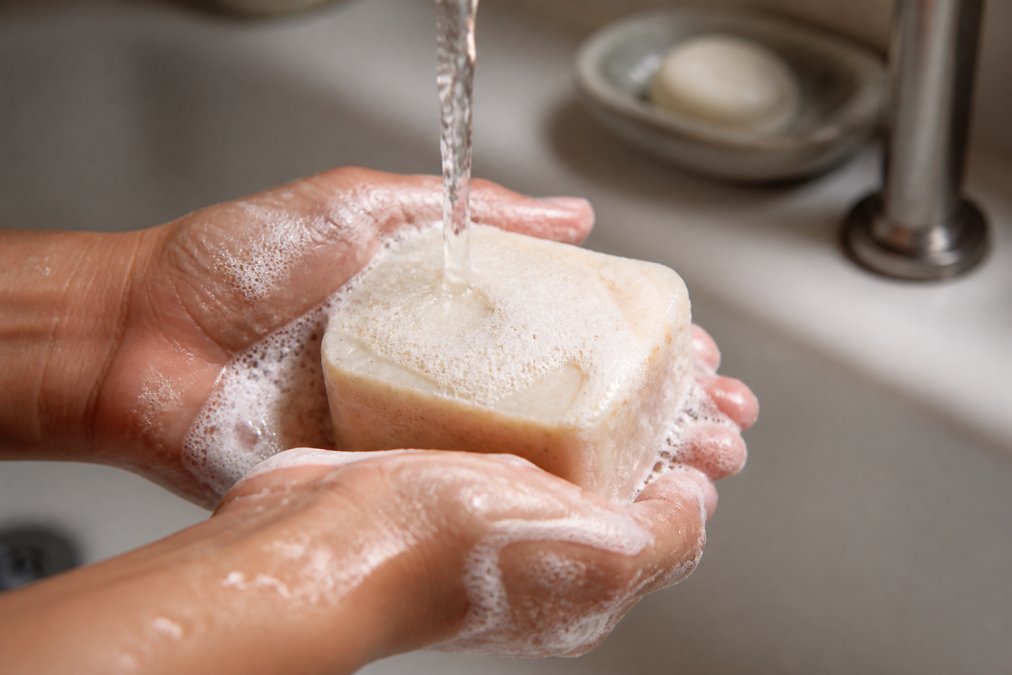
A well-cured artisan bar produces a dense, creamy lather rather than the large, airy bubbles of commercial detergent bars. Castor oil boosts lather creaminess, while shea butter and tallow add body to the foam. The texture feels more like a moisturizing cleanser than a traditional soap.
A handcrafted bar lasts as long as a commercial one if stored properly. A 4.5-ounce artisan bar used daily typically lasts three to four weeks. The key is keeping it dry between uses.
How to Store Handmade Soap for Longevity
Handmade soap is glycerin-rich, making it more water-soluble than commercial bars. Use a draining soap dish that lifts the bar off the wet surface. A bar left in a puddle of water will dissolve in days; one kept on a dry, ventilated rack can last weeks longer.
Cut or break the bar in half and store the unused portion in a cool, dry place. Rotate between two bars so each has time to dry fully between showers. These steps address the most common complaint about artisan soap without sacrificing moisturizing benefits.
Which One Should You Pick? A Decision Guide
Choose an artisan bar if you value transparent ingredients and skin-nourishing oils. Choose a commercial bar if your priority is maximum fragrance strength, rock-bottom price, or convenience. For most people with sensitive, dry, or eczema-prone skin, the artisan route is the better investment.
Minerva Rae offers a curated selection of handcrafted bars that suit different needs. For sensitive skin, the unscented Tallow & Goat Milk bar is the safest starting point. For relaxation, the Bulgarian Lavender soap combines purple clay and colloidal oats with pure lavender essential oil. For oily or blemish-prone skin, the Charcoal & Tea Tree bar uses activated charcoal and kaolin clay to clarify without stripping.

If you want a bar that cleanses, moisturizes, and does not leave your skin feeling tight, artisan bath and body products are the clear choice. If you are exploring this category for the first time, start with a single unscented bar and judge how your skin feels after a week.
Choosing between artisan and commercial soap comes down to ingredient transparency and skin feel. Minerva Rae crafts each bar using cold process and melt and pour methods, with premium oils, butters, and clays designed to nourish rather than strip. Every bar is made in small batches with high-quality, lasting ingredients. Explore the Collection and find a bar that turns your daily shower into a ritual worth keeping.
Frequently Asked Questions
What is the best artisanal soap for sensitive skin?
For sensitive skin, look for unscented artisan soaps made with simple, plant-based ingredients. A cold process bar like Minerva Rae's Tallow & Goat Milk, at $12.00, is an excellent choice. It contains no added fragrance or essential oils, reducing the risk of irritation. The combination of tallow and goat milk provides a creamy, gentle lather that cleanses without stripping the skin's natural moisture barrier.
Is Lux Naturals considered an artisan soap brand?
No, Lux Naturals is generally considered a mass-market brand rather than an artisan one. Artisan soap is defined by small-batch production, often using the cold process method, and a focus on high-quality, naturally derived ingredients. Mass-market brands typically use a continuous manufacturing process that generates more heat, which can destroy beneficial compounds. They also often rely on synthetic fragrances and detergents to cut costs.
What are the benefits of using cold process soap over mass-market alternatives?
The benefits of cold process soap include a higher glycerin content. Glycerin is a natural humectant that draws moisture to the skin. The low-heat method preserves the nourishing properties of oils and butters like shea butter and coconut oil. This results in a bar that cleanses gently while supporting your skin barrier, leaving it soft and hydrated. Mass-market soaps often remove glycerin to use in more profitable lotions.
How do I store handmade soap to make it last longer?
To store handmade soap for longevity, keep it in a well-draining soap dish that allows air to circulate. This prevents the bar from sitting in water, which softens and dissolves it quickly. Between uses, let it dry completely. For long-term storage, wrap bars in parchment paper and keep them in a cool, dry, dark place. Properly stored, a 4.5 oz artisan bar can last 3-4 weeks with daily use.
This article was written using GrandRanker