

Table of Contents
- Artisanal vs Commercial Soap: Key Differences at a Glance
- How Manufacturing Process Shapes Your Soap
- Natural Soap Ingredients vs Synthetic Detergents
- Why Commercial Soaps Strip Your Skin
- How to Choose the Best Bar Soap for Your Skin Type
- Durability and Value: Artisanal Soap Lasts Longer
- Environmental and Ethical Considerations
- Conclusion
- Frequently Asked Questions
Last Updated: September 4, 2026
Artisanal soap leaves your skin soft and hydrated; commercial bars often strip natural oils, leaving you tight and itchy. This guide explains the chemical and manufacturing differences so you can choose a bar that supports your skin rather than fighting it.
Artisanal vs Commercial Soap: Key Differences at a Glance
Artisanal soap is created through saponification, where natural oils and lye combine to form true soap and glycerin. Commercial bars are typically synthetic detergents made from petroleum-derived surfactants that clean but offer minimal skin benefit.
| Factor | Artisanal Soap | Commercial Soap Bars |
|---|---|---|
| Base ingredients | Natural oils, butters, tallow | Synthetic detergents, surfactants |
| Glycerin content | Naturally retained | Often removed and sold separately |
| Manufacturing | Cold process or hot process | Heat processing with glycerin extraction |
| Skin feel | Moisturized, soft | Tight, potentially stripped |
| Additives | Essential oils, botanicals, clays | Fragrance oils, parabens, preservatives |
| Price per bar | Higher | Lower |
How Manufacturing Process Shapes Your Soap
Manufacturing method determines whether a bar moisturizes or dries your skin.
Cold Process and Handcrafted Methods
Cold process soapmaking combines oils and lye at low temperatures, allowing slow saponification over 24-48 hours. The bars cure for weeks, retaining natural glycerin and the moisturizing properties of original oils and butters. This produces a richer lather that cleanses without disrupting your skin's acid mantle.
Commercial Manufacturing and Heat Processing
Commercial manufacturers use high-heat processing to complete saponification in hours, degrading beneficial fatty acids. They extract glycerin for separate sale, leaving a harsh base that requires synthetic moisturizers and preservatives. The result cleans dirt but compromises your skin barrier.
Natural Soap Ingredients vs Synthetic Detergents
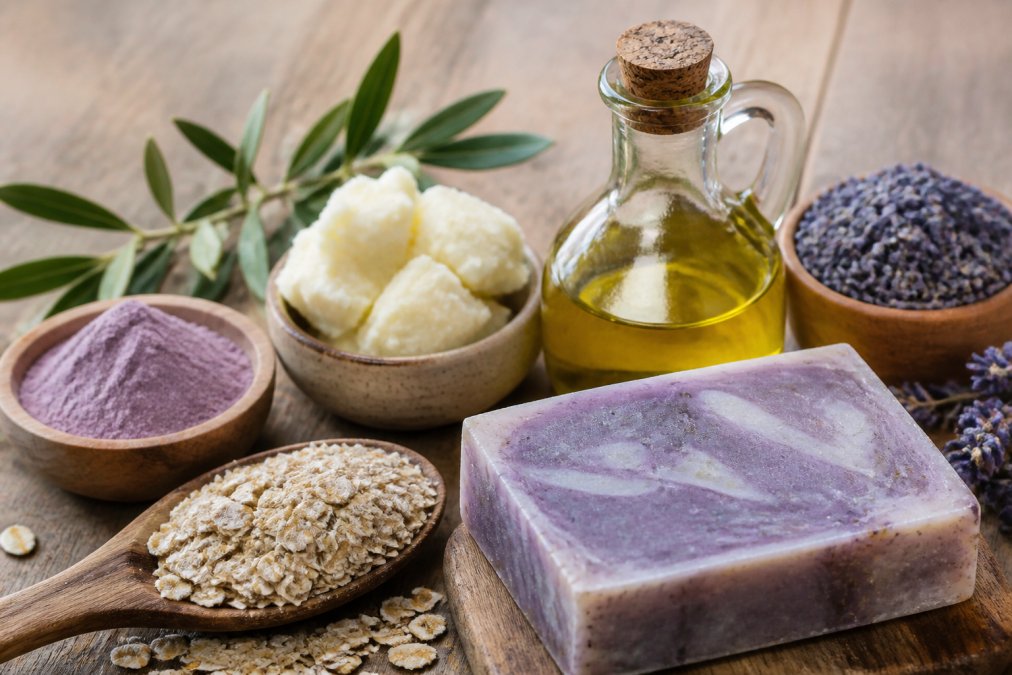
Reading an ingredient label reveals whether a bar is true soap or synthetic detergent, a chemical distinction that determines how it interacts with your skin.
Real soap contains saponified oils (olive, coconut, shea butter, tallow, castor) and sodium hydroxide. After saponification, only nourishing oils and glycerin remain, a humectant that draws moisture into your skin.
Synthetic detergent bars list sodium lauryl sulfate as their primary cleansing agent. These surfactants strip both dirt and your skin's natural protective oils indiscriminately. Dozens of unpronounceable ingredients signal a detergent product, not true soap.
Why Commercial Soaps Strip Your Skin
The tight, dry feeling after washing with a commercial bar is not your imagination; it is the predictable result of how those bars are formulated and how they interact with your skin's chemistry. Understanding the mechanism, particularly the role of pH, helps explain why so many people with sensitive skin find relief when they switch.
The pH Problem: Soap vs. Detergent Bars
Your skin's acid mantle (pH 4.5-5.5) protects against bacteria and moisture loss. True soap has a pH of 9-10, but artisanal makers compensate by superfatting recipes and retaining glycerin, which buffers alkalinity and restores the acid mantle quickly.
Commercial detergent bars use neutral-pH surfactants (7-8) that strip oils indiscriminately, disrupting the acid mantle by removing fatty acids that maintain it. This leaves your skin barrier compromised and vulnerable to irritation and water loss, the tight, itchy sensation signals protective layer damage.
Glycerin Removal and Its Impact
Glycerin is a humectant that pulls water into your skin. Commercial manufacturers remove it for separate sale, eliminating the most valuable skin-conditioning ingredient. Artisanal soaps retain glycerin naturally, leaving skin soft and hydrated with faster pH recovery.
Common Additives That Cause Dryness and Irritation
Commercial bars contain additives that worsen dryness and trigger sensitivity. Sodium lauryl sulfate (SLS) disrupts the skin barrier at concentrations as low as 2 percent. Synthetic fragrance oils often contain phthalates, the leading cause of allergic contact dermatitis in cosmetics. Parabens can trigger sensitivity reactions in susceptible individuals.
For those with dry skin, eczema, or rosacea, the combination of pH imbalance, glycerin removal, and harsh surfactants creates a triple assault on the skin barrier, which is why switching to artisanal soap often produces visible improvement within days.
How to Choose the Best Bar Soap for Your Skin Type
Choose a bar that matches your skin's specific needs. The right bar leaves skin clean but never tight.
For Sensitive and Dry Skin
For sensitive or dry skin, choose unscented bars with tallow and goat milk. Tallow's fatty acids mirror your skin's sebum; goat milk's lactic acid gently exfoliates while supporting the barrier. Minerva Rae's Tallow & Goat Milk bar ($12.00) cleanses without stripping.

For Oily and Acne-Prone Skin
For oily skin, choose activated charcoal bars that draw out impurities without synthetic harshness. Minerva Rae's Charcoal Swirl pairs charcoal with colloidal oats and silk. For combination skin, the Old Fashioned Tallow & Oatmeal bar offers gentle exfoliation.

Durability and Value: Artisanal Soap Lasts Longer
A properly cured artisanal bar outlasts most commercial alternatives when stored correctly. Commercial bars are aerated with soft fillers for quick lather but disintegrate fast. Cold process bars are dense and hard, lasting longer per use despite higher upfront cost.
How Artisanal Bars Outlast Commercial Alternatives
Commercial bars last 5-7 days of daily use; artisanal bars last 3-4 weeks. Commercial bars are aerated during manufacturing and collapse quickly. Artisanal bars cure for 4-6 weeks, hardening into dense blocks that deliver 20-30 showers versus 10-15 from commercial bars of similar weight.
An artisanal bar at $12.00 lasting 25 showers costs $0.48 per wash. A commercial bar at $2.00 lasting 12 showers costs $0.17 per wash, but adding lotion needed to repair stripped skin ($5.33/month) makes the commercial option more expensive overall.
Storage: The Critical Factor in Longevity
Artisanal soaps are vulnerable to melting, sweating, and rancidity, processes commercial bars resist more easily.
Melting and sweating occur when bars are exposed to moisture and humidity above 75°F, accelerating dissolution by 30-50 percent. Prevent this by storing bars on a wooden or slotted soap dish (not plastic) away from direct shower spray. In humid bathrooms, store backup bars in a cool, dry closet.
Rancidity develops over 6-12 months in warm conditions, signaling degraded skin-conditioning properties. Store bars in cool (below 70°F), dark places. Bars made with stable oils, coconut, palm, tallow, shea butter, resist rancidity longer.
The Math: Cost Per Wash Over Time
Proper storage extends an artisanal bar to 25 showers ($0.48/wash); poor storage reduces it to 12-15 showers ($0.80/wash). A commercial bar costs $0.17/wash but requires lotion ($5.33/month) to repair stripped skin, totaling $7.33/month. An artisanal bar at $0.48/wash costs around $12.00/month for 25 showers, comparable when accounting for full skincare needs.
Environmental and Ethical Considerations
Artisanal soaps are biodegradable and break down naturally without harming waterways. Commercial detergent bars contain surfactants and preservatives that persist in the environment.
Ethical sourcing is another differentiator. Small-batch makers often prioritize cruelty-free testing and ethically sourced ingredients, including fair-trade oils and butters. Many artisanal bars are also vegan, using plant-based oils instead of animal fats. If these values matter to you, researching a maker's sourcing practices is worthwhile. The FDA guidance on cosmetic labeling requires ingredient lists on all cosmetic products, so you can verify claims about natural ingredients and additives before purchasing. Similarly, the Environmental Working Group's skin deep database offers independent assessments of ingredient safety that can help you compare products. When you buy from a small maker, you can often ask directly about ingredient origins, something that is nearly impossible with mass-market brands.
Conclusion
The artisanal vs commercial soap decision ultimately comes down to whether you view soap as a commodity or as part of your daily skincare routine. Commercial bars offer convenience and low upfront cost, but they often strip your skin, rely on synthetic detergents, and contribute to packaging waste. Artisanal soaps cost more per bar, yet they deliver genuine moisturizing benefits through retained glycerin and natural oils, last longer with proper care, and align with ethical and environmental values. For those with sensitive or dry skin, the difference is not subtle; it is the difference between a shower that leaves you reaching for lotion and one that leaves your skin feeling balanced. Minerva Rae offers a curated collection of cold process soaps designed to bring this refined experience into your daily ritual, from the unscented Tallow & Goat Milk bar for sensitive skin to the aromatic Bulgarian Lavender for a calming, indulgent wash. American Academy of Dermatology guidance on choosing skin care products confirms that gentle, fragrance-free cleansers are the best choice for maintaining a healthy skin barrier. Explore the Minerva Rae collection and find a bar that treats your skin as carefully as you do.

Frequently Asked Questions
What are the main differences between artisanal soap and commercial soap bars?
Artisanal soaps are handcrafted using cold process or small-batch methods that preserve natural glycerin and skin-nourishing oils. Commercial soaps are mass-produced using heat and often have glycerin removed to reduce costs. Artisanal bars typically contain emollients like shea butter and tallow, while commercial soaps rely on synthetic detergents like sodium lauryl sulfate. This means artisanal soaps are gentler on your skin's acid mantle and less likely to cause dryness or irritation.
Are artisanal soaps better for sensitive skin?
Yes, artisanal soaps are generally better for sensitive skin. Handcrafted bars made with cold process methods retain glycerin naturally, which acts as a humectant to lock in moisture. They avoid harsh synthetic detergents and often skip parabens and phthalates that trigger reactions in sensitive skin. For example, an unscented artisanal bar like Tallow & Goat Milk uses only nourishing ingredients without fragrance oils, making it ideal for those with reactive or dry skin conditions.
Why does commercial soap feel drying compared to artisanal options?
Commercial soap manufacturers remove glycerin during production to sell it separately as a higher-margin product. This strips away the soap's natural moisturizing agent. Mass-produced bars also contain synthetic detergents and chemical surfactants that disrupt your skin's acid mantle, the protective barrier that keeps moisture in. Cold process artisanal soaps preserve glycerin and use gentler surfactants, so they cleanse without stripping your skin of its natural oils.
How long do artisanal soaps last compared to commercial bars?
Artisanal soaps typically last longer than commercial bars because they're denser and contain less water. A handcrafted bar that weighs 4.5 oz may last 3-4 weeks with daily use, while a commercial bar of similar size often lasts 10-14 days. This longer lifespan makes artisanal soaps more economical over time, despite a higher upfront cost. Proper storage in a well-draining soap dish also extends durability by allowing the bar to dry between uses.
What should I look for when choosing a bar soap for my skin type?
For dry or sensitive skin, look for soaps with emollients like shea butter, tallow, or goat milk, and avoid synthetic detergents and fragrance oils. For oily skin, choose bars with kaolin clay or activated charcoal for gentle cleansing without over-moisturizing. Check ingredient lists for parabens, phthalates, and sodium lauryl sulfate, these are red flags in commercial soaps. Cold process artisanal soaps tend to be formulated with skin type in mind, so look for bars that match your specific needs rather than generic 'all-purpose' options.
This article was written using GrandRanker