

Last Updated: November 2, 2026
Quick Summary
To identify phthalates in soap, turn the bar over and scan the ingredient declaration for six acronyms: DEP, DBP, DMP, BBP, DEHP, and DINP. If the label lists only fragrance or parfum, it neither confirms nor rules out phthalates, so ask the maker directly whether the scent blend is phthalate-free.
- Ignore front-label words like pure and natural; only the ingredient declaration lists what went into the soap.
- Ingredients are generally listed by weight, so a scent near the bottom is a small fraction of the formula.
- Learn DEP and DBP first, since most labels use acronyms rather than full chemical names.
- An unscented bar can still contain a masking fragrance listed as fragrance on the back panel.
- Phthalates can sit in the product or in plastic packaging, so treat those as two separate questions.
Table of Contents
- Start With the Ingredient Declaration, Not the Front Label
- The Phthalates in Cosmetics List: Names and Abbreviations to Scan For
- Your Soap Ingredient Label Guide: Reading the List Line by Line
- How to Avoid Phthalates in Soap and Body Care
- Soap Packaging Is Not the Same as Soap Ingredients
- What a Label Can and Cannot Tell You About Phthalates in Soap
- Choosing a Bar You Can Read With Confidence
- Frequently Asked Questions
Start With the Ingredient Declaration, Not the Front Label
Learning how to identify phthalates in soap labels starts with one rule: ignore the front of the package and turn the bar over. The ingredient declaration, usually printed in small type on the back or bottom, is the only part of the label that lists what actually went into the soap.
Front labels sell a mood. Words like "pure," "natural," and "fresh" are marketing, not chemistry.
The back panel is different. Ingredients are generally listed by weight, from most to least (the FDA). That order alone tells you a lot. If "fragrance" sits near the top, the scent is a big part of the formula. If it sits near the bottom, it is a trace of the recipe.
Here is what to do first:
- Find the word "Ingredients" or "Ingredient Declaration."
- Read from top to bottom, not left to right.
- Note anything you do not recognize.
- Compare that list against the phthalate names below.
That takes about thirty seconds. It is the fastest way to spot a problem before you buy.
The Phthalates in Cosmetics List: Names and Abbreviations to Scan For
Phthalates are a group of chemical compounds used to make plastics soft and to help scents last longer. In personal care products, they often hide behind short acronyms. The phthalates in cosmetics list below covers the names most often flagged in beauty products and soap.
The Six Most Common Phthalate Acronyms
Scan the ingredient list for these six names and their abbreviations:
| Full Chemical Name | Acronym | Common Use |
|---|---|---|
| Diethyl phthalate | DEP | Fixes fragrance so scent lingers |
| Dibutyl phthalate | DBP | Softens plastic, found in nail products |
| Dimethyl phthalate | DMP | Solvent in some formulations |
| Butyl benzyl phthalate | BBP | Plasticizer in packaging and vinyl |
| Di-2-ethylhexyl phthalate | DEHP | Softens plastic packaging |
| Diisononyl phthalate | DINP | Industrial plasticizer |
A common mistake is scanning only for the long chemical names. Most labels use the acronym, so learn DEP and DBP first. They are the two you will meet most often in body care.
For a wider list of problem ingredients beyond phthalates, see our guide to handcrafted soap ingredients to avoid.
Your Soap Ingredient Label Guide: Reading the List Line by Line
A soap ingredient label guide works best when you read it in order, the same way the maker wrote it, and when you test the advice against a real panel. Here is a representative cold-process bar ingredient declaration, the kind you will find on the back of a wrapped bar:
Saponified oils of olive, coconut, and shea butter; water; glycerin; fragrance; titanium dioxide; mica.
Read it line by line.
Start at the top. The first entries are the bulk of the bar: the saponified oils and water that make up most of its weight.
Move to the middle. Glycerin, a natural byproduct of saponification, often appears here, along with butters, clays, and colorants. Titanium dioxide is a common whitener; mica is a common colorant.
Then check the end. Preservatives, scent, and color appear last because they are used in small amounts. In the panel above, "fragrance" sits near the end, which tells you the scent is a small fraction of the formula, not its backbone.
Now run the phthalate scan against this same panel. None of the six acronyms from the list above appears, so nothing is disclosed by name.
Compare that with a panel that reads "fragrance (lavender essential oil, cedarwood essential oil)." The scent is still grouped under one term, but the parenthetical names give you more to evaluate.
Watch out: ingredient order is by weight in the formula, not by importance to your skin.
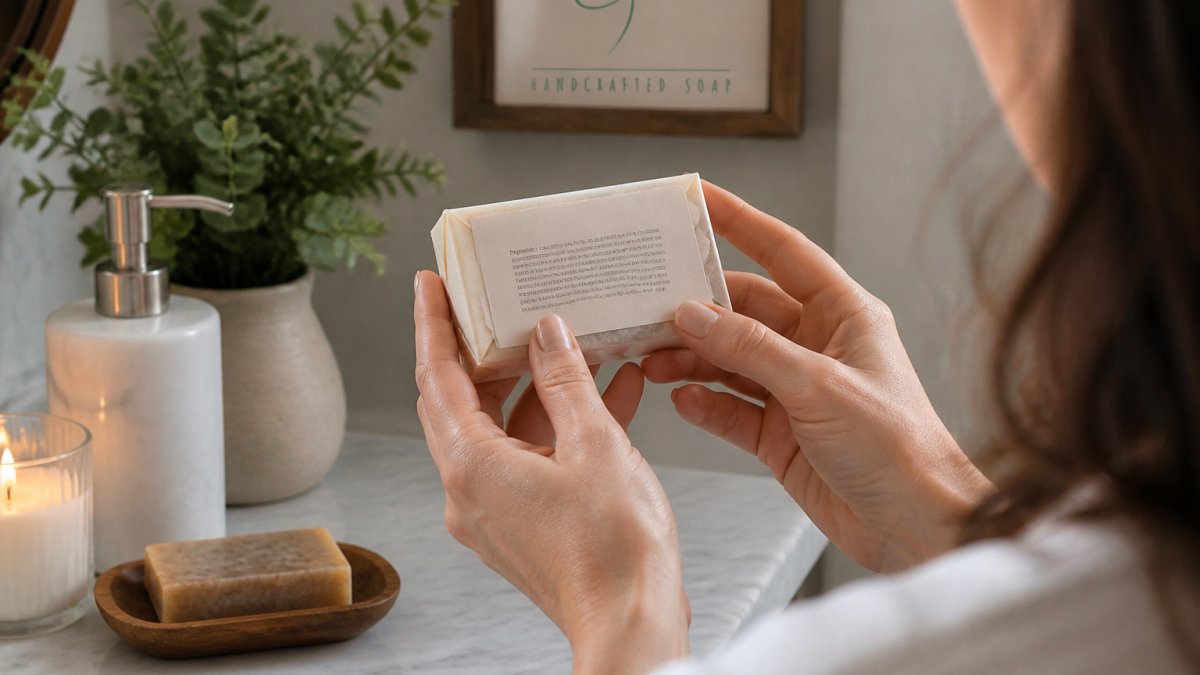
What you can do is look for signals and then ask. A maker who lists each essential oil by name, such as lavender oil or cedarwood oil, is being more transparent than one who writes only "fragrance." Neither label proves anything about phthalates, but the named-oil label gives you more to work with.
Watch out: a label that says "unscented" is not the same as "fragrance-free." An unscented bar can still contain a masking fragrance, and that masking fragrance can itself be listed as "fragrance." Read the ingredient list, not the front claim, and treat "unscented" as a marketing term until the back panel backs it up.
How to Avoid Phthalates in Soap and Body Care
To avoid phthalates, focus on what you can control: the products you choose and how you read them. You cannot test a bar at the shelf, but you can make smarter picks.
Start with these steps:
- Read the full ingredient list on every bar, every time.
- Scan for the six acronyms above.
- Prefer bars that name their scent ingredients.
- Choose products with short, readable ingredient lists.
- Ask the maker directly about fragrance sources.
That last step matters. Many soap makers can tell you what is in the scent blend. If you are avoiding fragrance entirely, see our guide on how to choose fragrance-free soap for sensitive skin. Ask directly and see how the answer is given.
A Printable Checklist for Your Next Soap Purchase
Use this list at the store or while you shop online:
- I found the ingredient declaration, not just the front label.
- I read the list from top to bottom.
- I scanned for DEP, DBP, DMP, BBP, DEHP, and DINP.
- I noted whether the label says "fragrance" or "parfum."
- I checked whether scent ingredients are named.
- I confirmed the bar is labeled fragrance-free if I want no scent.
- I asked the maker about scent sources when buying online.
Seven checks. Two minutes. That is the whole routine.
Soap Packaging Is Not the Same as Soap Ingredients
A recycling symbol on the box says nothing about what is inside the bar. This trips up a lot of shoppers.
Phthalates show up in two very different places. They can be in the product ingredients, or they can be in the plastic wrap and packaging around it. A soft vinyl wrapper or a plastic sleeve may contain phthalates as a plasticizer.
Soap packaging and soap ingredients are separate questions. A bar wrapped in phthalate-free paper can still contain fragrance with phthalates inside it. A bar with a simple ingredient list can sit in packaging that contains them.
Keep the two apart in your mind:
- Ingredients tell you what touches your skin.
- Packaging tells you what touches the bar before you open it.
Read the ingredient list for skin contact. Read the packaging for waste and recycling. Do not let one answer stand in for the other.
What a Label Can and Cannot Tell You About Phthalates in Soap
A label can tell you a lot, but it cannot tell you everything. Knowing the difference keeps you from false confidence.
What a label can tell you:
- Whether a phthalate is listed by name or acronym
- Whether the product uses "fragrance" or "parfum" as a catch-all
- Whether scent ingredients are named individually
- Whether the bar claims to be fragrance-free
What a label cannot tell you:
- Whether a "fragrance" blend contains phthalates
- Whether trace amounts came in with a raw ingredient
- Whether the packaging contains phthalates
- Whether an "organic" claim covers the whole bar
That last point matters. An organic claim may apply only to specific ingredients rather than the entire product. It says nothing about phthalates in a scent blend.
For a deeper look at how natural and synthetic ingredients differ on a label, read natural vs synthetic ingredients in bar soap.
The honest takeaway: a label is a strong first filter, not a lab test. Use it to rule out the obvious, then ask the maker about the rest.
Choosing a Bar You Can Read With Confidence
The best soap label is one you can read without a chemistry degree. For help judging overall quality, see our buyer's guide to finding high quality soap. Short lists, named ingredients, and clear scent sources are the marks of a maker who has nothing to hide.
Minerva Rae creates handcrafted soaps and body care using cold process and melt and pour methods, with a focus on premium ingredients and an intentionally curated product line.
A few things to look for as you choose:
- An ingredient list you can read out loud
- Scent ingredients named, not hidden
- A maker who answers questions about sourcing
Frequently Asked Questions
How can you tell if phthalates are in a soap product?
Turn the bar over and read the full ingredient declaration, not the front label. Look for names like diethyl phthalate (DEP), dibutyl phthalate (DBP), dimethyl phthalate (DMP), or butyl benzyl phthalate (BBP). If the list only says fragrance or parfum, the individual components are not disclosed, so you cannot confirm or rule out phthalates from the label alone. A short, fully spelled-out ingredient list gives you the most to work with.
Can phthalates be hidden under the word fragrance on a soap label?
Yes. A fragrance blend can be listed as a single term without naming its individual components, so a bar listing parfum gives you no way to verify its contents. If avoiding phthalates matters to you, choose soaps that state their scent comes from named essential oils or that carry a fragrance-free declaration.
Does fragrance-free mean a soap contains no phthalates?
Not automatically. Fragrance-free means no scent has been added, which removes the most common route for phthalates in soap, but the term is not a guarantee about every ingredient. Read the rest of the declaration for plastic-related names and check whether the manufacturer explains its fragrance policy. A bar with a short, readable list and a clear statement about scent sources is easier to trust than one relying on the phrase alone.
Are phthalates required to be listed separately in cosmetics and soap?
Ingredients added intentionally are generally expected to appear on the declaration, but components of a fragrance blend may not be broken out individually. That is the gap that makes label reading imperfect. Your practical move is to scan for the known acronyms, treat undisclosed fragrance as an unknown, and favor makers who publish full ingredient lists and answer questions about how they scent their bars.
Reading soap labels for phthalates takes practice, but the routine is simple: check the back, scan the acronyms, and ask about scent. We built Minerva Rae for shoppers who want that clarity, with handcrafted soaps made using cold process and melt and pour methods, intriguing designs, and ingredients we are glad to list. Explore the collection and find a bar you can read with confidence.
