

Table of Contents
- Natural vs Synthetic Ingredients in Bar Soap: The Core Difference
- True Soap, Syndet Bars, and Products Marketed as Soap
- Natural Soap vs Commercial Soap: What Actually Changes
- Oils, Fats, and Surfactants: An Ingredient-by-Ingredient Comparison
- Bar Soap Ingredients to Avoid (and When to Stop Worrying)
- How to Read Soap Ingredient Labels Like a Formulator
- Natural vs Organic Soap: Why the Labels Are Not Interchangeable
- Matching the Bar to Your Skin: Selection Criteria That Matter
- Conclusion
- Frequently Asked Questions
Last Updated: October 17, 2026
Natural vs Synthetic Ingredients in Bar Soap: The Core Difference
The core difference between natural vs synthetic ingredients in bar soap comes down to chemistry, not marketing. Natural bar soap is made when plant or animal fats react with lye to form fatty acid salts, while synthetic bars rely on lab-made surfactants to do the cleaning.
Here is the part most guides skip: not every bar sold as "soap" is actually soap. Many commercial bars are syndet bars, a blend of synthetic surfactants pressed to look like soap.
Below, we break down both categories ingredient by ingredient so you can choose with confidence.
True Soap, Syndet Bars, and Products Marketed as Soap
True soap is the product of saponification: a fat or oil plus an alkali, yielding fatty acid salts and glycerin.
The Food and Drug Administration's guidance on soap labeling draws this line clearly. A product qualifies as soap only when its cleansing action comes from fatty acid salts made through saponification. Otherwise, it falls under cosmetic or drug rules.
That legal split matters for shoppers. A "beauty bar" or "cleansing bar" is usually a syndet. Nothing is wrong with that, but you deserve to know which one you are buying before it touches sensitive skin.
Natural Soap vs Commercial Soap: What Actually Changes
In natural soap vs commercial soap, the biggest change is what stays in the bar. Traditional cold-process soap keeps its glycerin, a humectant that draws moisture toward your skin. Many large commercial makers extract glycerin to sell separately, leaving a bar that cleans well but conditions less.
Commercial bars also lean on synthetic fragrance, colorants, and preservatives to guarantee a consistent look and scent across millions of units. Natural bars vary slightly from batch to batch because real ingredients vary.
Neither approach is dishonest. They solve different problems, and knowing which problem you want solved is the whole game.
Glycerin, Lather, and Skin Feel
Glycerin is the quiet hero of a good bar. It is a humectant, meaning it helps skin hold onto water, and it is a natural byproduct of saponification. In practice, this means a glycerin-rich bar often leaves skin feeling soft rather than tight.
Lather tells a more complicated story. Synthetic surfactants foam easily even in hard water, while natural soap can produce a creamier, lower-volume lather. Low foam does not mean low cleaning power. It usually means the bar is doing its job without harsh detergents.
Oils, Fats, and Surfactants: An Ingredient-by-Ingredient Comparison
Natural bars are built from plant-based oils and animal fats, each chosen for a specific job. Coconut oil gives cleansing and bubbles, olive oil conditions, shea butter and sal butter soften, and castor oil stabilizes lather. Our Tallow & Goat Milk bar, for example, pairs tallow and goat milk with olive, coconut, and castor oils for a creamy, gentle lather.

Synthetic bars swap those for surfactants such as sodium lauroyl sarcosinate or sodium cocoyl isethionate, plus petroleum-based ingredients in some formulas. These create reliable foam and a uniform feel.
How the Same Oils Show Up Differently on a Label
The clearest way to compare like with like is to follow one oil through both chemistries. On a true soap label, coconut oil does not appear as "coconut oil." It appears as the fatty acid salts created when it reacts with lye: sodium cocoate, sodium laurate, and sodium myristate. Olive oil becomes sodium olivate.
On a syndet bar, the same coconut-derived building blocks are rebuilt into surfactants instead. Sodium cocoyl isethionate, sodium lauroyl sarcosinate, cocamidopropyl betaine, and sodium lauryl sulfoacetate are common examples. Some are coconut-derived, which is why "plant-based" and "synthetic" are not opposites.
pH and the Cleansing Mechanism
True soap is alkaline, typically landing around pH 9 to 10, because fatty acid salts need that range to stay soluble and effective. That alkalinity is part of why soap cleans well and also part of why it can leave some skin feeling tight.
Neither number is a verdict. A well-formulated alkaline soap with retained glycerin can be comfortable for many skin types, and a poorly formulated syndet can still strip skin. But knowing the pH range tells you what to expect and why the two categories feel different on the same skin.
Side-by-Side Comparison
| Feature | Natural Soap | Syndet Bar |
|---|---|---|
| Cleansing agent | Fatty acid salts (sodium cocoate, sodium olivate, sodium tallowate) | Synthetic surfactants (sodium cocoyl isethionate, sodium lauroyl sarcosinate, cocamidopropyl betaine) |
| Typical pH | About 9 to 10 | About 5 to 6 |
| Glycerin | Often retained from saponification | Often removed or added back |
| Lather in hard water | Creamier, lower foam | Consistent, high foam |
| Skin feel | Soft, sometimes tight if over-cleansed | Smooth, engineered consistency |
| Ingredient list | Short, recognizable | Longer, includes synthetics |
Bar Soap Ingredients to Avoid (and When to Stop Worrying)
The bar soap ingredients to avoid depend on your skin, not on a universal blacklist. For sensitive skin, the usual suspects are synthetic fragrance, dyes, and harsh sulfates, which can trigger irritation in some people.
Here is the honest caveat most guides skip: "natural" does not automatically mean gentler. Essential oils and botanicals can irritate sensitive skin too. If your skin reacts, the fix is reading the label and patch-testing.
How to Read Soap Ingredient Labels Like a Formulator
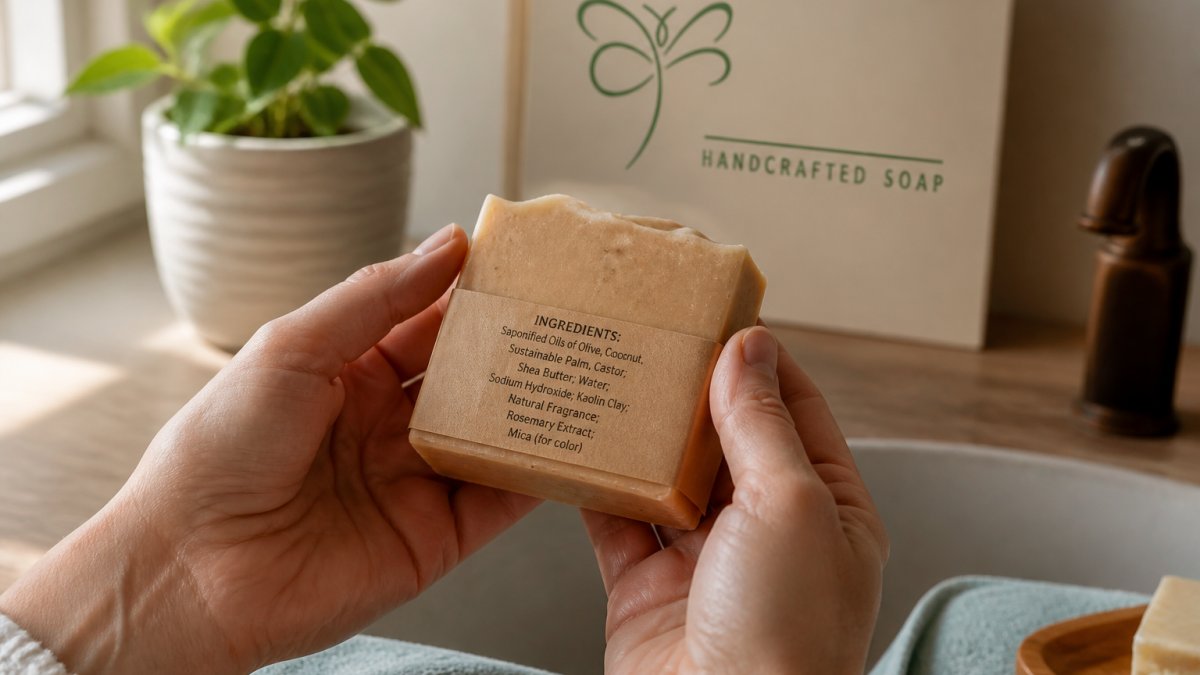
Reading a soap label like a formulator means scanning for two things: the cleansing agent and the conditioning ingredients. Ingredients are listed by weight, so what appears first dominates the bar.
Start with the first three to five ingredients. If you see saponified oils and butters, you are looking at true soap.
The Five Things to Find on Any Bar
Every cleansing bar label, natural or synthetic, contains the same functional categories. Knowing how each one is written is what separates label literacy from label guessing.
- The cleansing agent. On true soap, look for fatty acid salts: sodium cocoate, sodium olivate, sodium palmate, sodium tallowate, sodium shea butterate. On a syndet bar, look for surfactants: sodium cocoyl isethionate, sodium lauroyl sarcosinate, cocamidopropyl betaine, sodium lauryl sulfoacetate, sodium lauryl sulfate. Whichever appears first is doing most of the cleaning.
- The humectant. Glycerin is the most common. On a true soap label it may not be listed separately because it is created during saponification and stays in the bar. On a syndet label, glycerin is usually added back and appears by name. Other humectants include sorbitol and propylene glycol.
- Fragrance. Listed as "fragrance" or "parfum," or as individual essential oils such as lavender oil or citrus peel oil. "Fragrance-free" and "unscented" are not the same claim, as noted below.
- Preservatives. When present, common names include sodium benzoate, potassium sorbate, and tetrasodium EDTA (a chelator rather than a preservative).
- Colorants. Look for CI numbers (such as CI 77891 for titanium dioxide) or names like iron oxides, mica, and ultramarines. Natural bars may use clays or botanicals instead.
A Worked Example
Imagine two labels. The first reads: sodium tallowate, sodium cocoate, water, glycerin, sodium olivate, fragrance, sodium chloride. The leading -ate salts tell you this is true soap, glycerin is retained, and the list is short.
Neither label is a red flag on its own. The point is that you can now tell which chemistry you are buying before you spend money on it.
Then check the tail end. Fragrance, colorants, and preservatives usually live there in small amounts. A short, readable list is a good sign, but length alone is not proof of quality. Context matters more than a clean-looking label.
Natural vs Organic Soap: Why the Labels Are Not Interchangeable
Natural vs organic soap is not a case of one being a stricter version of the other. "Natural" has no legal definition for soap and can mean almost anything a maker intends.
A bar can be natural without being organic, and an organic ingredient can still be processed into something synthetic. When a label claims organic, look for a recognized certifier rather than taking the word at face value.
This is where label literacy pays off. The word on the front is marketing. The list on the back is the truth.
Matching the Bar to Your Skin: Selection Criteria That Matter
Matching a bar to your skin comes down to three factors: your skin type, your sensitivity, and how the bar performs in your water.
For very dry or reactive skin, our unscented Tallow & Goat Milk bar is built for exactly that. If you want light exfoliation, the Old Fashioned Tallow & Oatmeal bar uses finely ground oatmeal for a gentle scrub.

Bar longevity matters too. A well-cured natural bar kept on a draining dish lasts longer than one left sitting in water. Store it dry and it rewards you.
Conclusion
Choosing between natural and synthetic bar soap is really a choice about what you want from your daily wash: reliable foam or skin-friendly conditioning, a short ingredient list or engineered consistency. Neither is wrong, but the difference is real and worth understanding.
At Minerva Rae, we handcraft every bar using cold process and melt and pour methods, with premium ingredients and designs made to be lingered over.
Explore the Collection and find the bar that fits your skin, your senses, and your standards.
Frequently Asked Questions
What is the difference between natural and synthetic soap ingredients?
Natural bar soap is built on fatty acid salts created when plant or animal oils react with sodium hydroxide. Those oils might include coconut oil, olive oil, shea butter, or tallow. Synthetic ingredients in bar soap are detergent surfactants such as sodium cocoyl isethionate, which clean without saponification. Both can cleanse well. The difference shows up in pH, how the bar feels on skin, and how the ingredient list reads. A bar labeled natural may still contain fragrance or colorants, so the label is the only reliable guide.
Which bar soap ingredients should I avoid if I have sensitive skin?
Start with added fragrance and essential oils, which are common triggers for irritation. Also watch for dyes and strong exfoliants if your skin is reactive. Among bar soap ingredients to avoid for dry or sensitive skin, high-fragrance formulas and heavily perfumed syndet bars top the list. Unscented bars built on tallow, olive oil, or goat milk tend to suit reactive skin. Patch test any new bar on your inner arm for a few days before using it on your face or whole body.
Does natural bar soap work as well as conventional soap?
For everyday cleansing, yes. Natural soap removes dirt and oil effectively, and cold-process bars often retain glycerin, a humectant that helps skin hold moisture. The trade-offs are real: natural soap has a higher pH than syndet bars, can leave film in hard water, and may soften faster if it sits in water. Conventional and syndet bars lather more predictably in hard water and may last longer. Performance depends on the formula, not the natural label alone.
How can I tell whether a bar soap is truly natural?
Read the full ingredient list, not the front label. A true natural soap lists saponified oils, water, and sodium hydroxide, sometimes with clay, oatmeal, or botanicals. If the first ingredients are synthetic surfactants, the bar is a syndet, not soap. Words like "natural" and "clean" are not tightly regulated on soap packaging, so treat them as marketing. Certifications such as USDA Organic carry actual standards. When in doubt, look for short lists with recognizable oils and butters.