

Table of Contents
- Why Sensitive Skin Reacts to Fragrance
- Fragrance-Free vs Unscented Soap: What's the Real Difference
- How to Identify Hidden Fragrances in Skincare
- Best Soap Ingredients for Sensitive Skin
- Scented vs Unscented Soap: Which One Should You Choose?
- Sensitive Skin Soap Comparison: Unscented vs Scented Options
- Frequently Asked Questions
Last Updated: September 13, 2026
Why Sensitive Skin Reacts to Fragrance
Fragrance is the leading cause of allergic contact dermatitis in skincare, and soap is where most people first meet it (the American Academy of Dermatology). The American Academy of Dermatology tracks it as one of the most common triggers for reactive skin, and that reaction has nothing to do with how "natural" a scent claims to be.
When skin is sensitive, its barrier is already compromised. Fragrance chemicals are small molecules that slip through, and the immune system treats them as intruders, producing redness, itching, burning, and sometimes a rash that takes days to fade.
A common mistake is assuming a floral or citrus scent is gentle because it comes from a plant. Essential oils are still concentrated chemical compounds that can provoke the same irritation as synthetic fragrance. If your skin stings after a shower, suspect the scent first.
Fragrance-Free vs Unscented Soap: What's the Real Difference
Fragrance-free and unscented soap are not the same thing. Fragrance-free means no fragrance has been added at all. Unscented means the product has no noticeable smell, a very different claim.
A soap can be labeled unscented and still contain a fragrance chemical. Manufacturers add masking agents that neutralize or cover the scent of raw ingredients without adding a recognizable perfume. The bar smells like nothing. It is not fragrance-free.
Fragrance-free soap is a soap formulated with no added fragrance compounds, whether synthetic or essential oil, so there is nothing present to trigger a scent-related reaction.
For reactive skin, fragrance-free is the safer label. Unscented tells you what your nose detects. Fragrance-free tells you what your skin will meet.
What 'Unscented' Actually Means on a Label
On a label, "unscented" is a marketing term, not a regulatory guarantee. The FDA regulates cosmetic labeling, including soap, but does not require an unscented product to be free of fragrance ingredients (the FDA). A bar can carry the word unscented and a fragrance compound in the same ingredient list.
That leaves the decision with you: read the ingredient panel, not the front of the package. If you see "fragrance," "parfum," or "aroma" anywhere in the list, the bar is not fragrance-free, no matter what the label promises.
How to Identify Hidden Fragrances in Skincare
Hidden fragrance hides behind several names, and "fragrance" is only the most obvious one. The FDA allows that single term to stand in for a blend of dozens of compounds, so one word can conceal a long list of potential irritants. Label reading alone is not enough, you need a protocol.
The Label-Reading Protocol
Work through the ingredient panel in this order:
- Scan for the catch-all terms first. Fragrance, parfum, aroma, and "natural fragrance" are the primary names. If any appears, the bar is not fragrance-free.
- Check for essential oils by name. Lavender, citrus, peppermint, tea tree, eucalyptus, litsea cubeba, and rosemary are common. Essential oils are concentrated compounds that can provoke the same irritation as synthetic fragrance.
- Look for masking agents. These hide the smell of other ingredients. Common names include ethyl vanillin, benzyl acetate, and various "-one" and "-al" compounds, though they do not always appear by name, which is why an explicit fragrance-free claim paired with a short ingredient list is the most reliable signal.
- Flag botanical extracts. Plant-derived compounds like chamomile, calendula, and aloe can carry scent even when not listed as fragrance. They are neither automatically irritants nor automatically safe.
- Confirm the claim against the panel. If the front says fragrance-free and the panel contains none of the above, the bar is genuinely free of added scent. If the two disagree, trust the panel.
The 24-Hour Patch Test Protocol
Most articles tell you to patch test and stop there. Here is the actual protocol.
Step 1: Choose the site. The inner forearm is standard, but for soap the upper outer arm or side of the neck better predicts how the bar behaves on face and body. Use one site per product so you can tell reactions apart.
Step 2: Prepare the skin. Wash the site with plain water and pat dry. Do not apply lotion, and do not test on broken, sunburned, or freshly shaved skin.
Step 3: Apply the product. Lather the bar and apply a quarter-sized amount to the test site. Leave it on for the length of a normal wash, then rinse with lukewarm water and pat dry. Do not scrub.
Step 4: Wait 24 hours. Do not wash the site again during this window. Check at the 24-hour mark for redness, itching, burning, or small bumps.
Step 5: Wait another 24 hours if clear. Some contact reactions are delayed. If the site is calm at 48 hours, the bar is likely safe for wider use. If a reaction appears at any point, stop using it and note the ingredient list for future comparison.
Step 6: Repeat on a second site if you are highly reactive. For diagnosed eczema, rosacea, or contact dermatitis, a single-site test is not always enough. Test on the forearm and the neck, since skin thickness and oil production differ between sites.
Masking Agents and Fragrance-Free Claims
Masking agents make a product smell like nothing while it still contains fragrance. They are why "unscented" and "fragrance-free" get confused, and why sensitive skin reacts to a bar that seemed safe.
The fix is simple: look for an explicit "fragrance-free" claim, then confirm it against the ingredient list. If both agree, the bar is genuinely free of added scent.
Minerva Rae's unscented bars follow this standard. The Tallow & Goat Milk bar is made without added fragrance or essential oils, and the full ingredient list is short enough to read in one pass: tallow, olive oil, water, goat milk, coconut oil, sodium hydroxide, and castor oil. Nothing on that list exists to add scent.

Best Soap Ingredients for Sensitive Skin
Sensitive skin does not need fewer ingredients so much as the right ones, and the base fats matter more than any additive. But the ingredient list is only half the story. The other half is pH, and most soap articles skip it entirely.
Why pH Matters More Than the Scent
Healthy skin sits at an acidic pH of roughly 4.5 to 5.5. That acidity keeps the microbiome in balance, supports the enzymes that rebuild lipids between skin cells, and slows irritant-loving bacteria. Traditional bar soap is alkaline, often pH 9 to 10, because saponified fats and lye produce an alkaline salt. Every wash pushes skin pH upward, and for compromised skin that shift can take hours to correct.
The practical takeaway: a fragrance-free bar built on traditional saponification is not automatically gentle. It removes the scent trigger, the biggest single win, but can still leave the barrier alkaline and stripped. Look for a lower-pH formulation, or saponified fats paired with goat milk, colloidal oats, and glycerin-rich oils, which help skin return to its natural acidity faster.
The Base Fats That Do the Work
Look for these in a bar:
- Tallow and shea butter, rich in stearic and oleic acids, which leave a protective, occlusive feel after rinsing and slow water loss through the barrier
- Olive oil, a mild cleansing base high in squalene and oleic acid, gentle enough for daily use on reactive skin
- Goat milk and colloidal oats, soothing additions that carry lactic acid and beta-glucans, both of which support the skin barrier
- Castor oil, adds a creamy lather without harsh detergents, so the bar rinses clean without a squeaky, stripped finish
- Kaolin clay, gentle cleansing for oily or blemish-prone skin, absorbing excess sebum without the aggressive surfactants found in many commercial bars
What to Avoid, and Why
Avoid bars built on harsh sulfates and synthetic detergents. Sodium lauryl sulfate and sodium laureth sulfate are effective surfactants, but they bind to skin proteins and strip the lipid barrier aggressively, leaving sensitive skin tight, red, and slow to recover between washes. Cocamidopropyl betaine is milder but still designed for high lather, and high lather usually means more surfactant residue left on skin.
Also watch for synthetic dyes, which serve no cleansing purpose and are a known contact irritant, and chelating agents like EDTA that can disrupt the skin microbiome. None belong in a bar for reactive skin.
Scented vs Unscented Soap: Which One Should You Choose?
Unscented soap wins for most people with sensitive skin, because it removes the most common trigger before it ever touches your skin. Scented soap can still work, but only when the scent comes from a low-irritation source your skin has already proven it tolerates.
Here is the decision in plain terms:
| Your Situation | Choose | Why |
|---|---|---|
| Diagnosed eczema, rosacea, or contact dermatitis | Fragrance-free | Removes the most common trigger entirely |
| Dry skin that flares in winter | Fragrance-free | Fewer irritants, more barrier-friendly fats |
| Skin tolerates scent but you prefer a lighter routine | Fragrance-free | Simplest path to fewer reactions |
| No history of reaction, want a sensory ritual | Scented, tested first | Scent adds enjoyment when skin allows it |
The trade-off is real: fragrance-free bars give up the sensory pleasure of scent, and for some people that ritual matters. The safe way to keep it is to patch test a scented bar before committing.
When Scented Soap Still Works for You
Scented soap can work when the fragrance is a single, recognizable essential oil rather than a synthetic blend, and your skin has no history of reacting to it. Essential oils are not automatically gentle, but some, like lavender, are widely used for calming and relaxation.
The rule is simple: introduce one scented bar at a time, patch test it, and stop at the first sign of redness or itching. If your skin stays calm through a full bar, you have your answer; if it reacts, you have saved yourself a drawer full of unusable bars.
Sensitive Skin Soap Comparison: Unscented vs Scented Options
Unscented bars are the safer default for reactive skin; scented bars are the reward for skin that has proven it can handle them. The comparison below lays out both sides across the factors that decide the outcome.
| Factor | Unscented / Fragrance-Free | Scented |
|---|---|---|
| Irritation risk | Lowest | Depends on the fragrance source |
| Best for | Eczema, rosacea, contact dermatitis | Skin with no reaction history |
| Ingredient list | Shorter, easier to verify | Longer, requires label reading |
| Sensory experience | Minimal | Adds a ritual element |
| Patch testing needed | Rarely | Always |
| Example | Tallow & Goat Milk | Bulgarian Lavender, Turmeric & Honey |
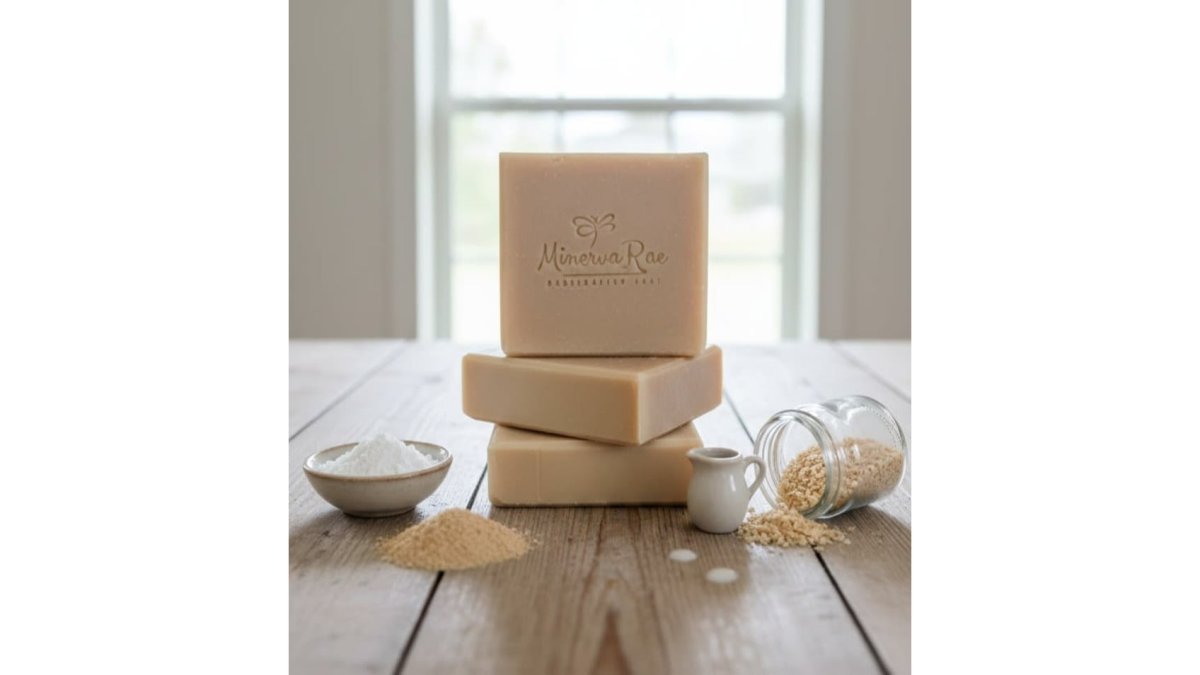
For a fragrance-free starting point, Minerva Rae's Tallow & Goat Milk bar is built on tallow, goat milk, and olive oil with no added fragrance or essential oils, the easiest bar to recommend when you do not yet know what your skin will tolerate. If your skin has handled scent before, Bulgarian Lavender uses pure lavender essential oil rather than a synthetic blend, and Turmeric & Honey pairs orange and litsea cubeba essential oils for a brighter, citrus-forward bar.
The unscented side of the lineup is not limited to one bar. Old Fashioned Tallow & Oatmeal combines tallow, shea butter, and finely ground oatmeal for light exfoliation. Charcoal & Tea Tree uses activated charcoal and kaolin clay for oily or blemish-prone skin. Every bar is handcrafted and lists its full ingredients so you can check the label before it reaches your bathroom.

Frequently Asked Questions
What type of soap is best for very sensitive skin?
Unscented, fragrance-free bars made with gentle ingredients like tallow, olive oil, and goat milk are the safest choice for very sensitive skin. These ingredients clean without stripping the skin barrier, which reduces redness and irritation. Look for short ingredient lists without synthetic fragrance, essential oils, or harsh sulfates. A bar like Minerva Rae's Tallow & Goat Milk ($12) is made specifically for sensitive or dry skin and contains no added fragrance or essential oils.
What is the difference between fragrance-free and unscented soap?
Fragrance-free soap contains no fragrance ingredients at all, whether added for scent or to mask the smell of other ingredients. Unscented soap may contain masking agents that neutralize odor without adding a noticeable scent. For sensitive skin, fragrance-free is the safer label because masking agents can still trigger allergic reactions. Always check the full ingredient list, not just the front label, to confirm what you're actually getting.
Can scented soap cause contact dermatitis?
Yes. Fragrance is one of the most common causes of contact dermatitis, a red, itchy reaction that appears where soap touches the skin. Both synthetic fragrance and essential oils can trigger it. If you notice redness, burning, or flaking after washing, switch to an unscented bar and patch test any new product on your inner forearm for 24 to 48 hours before using it on your face or body.
Are essential oils considered fragrance in soap?
Yes. Essential oils like lavender, tea tree, and citrus are fragrance ingredients, even though they come from plants. They can still cause irritation, redness, and allergic reactions in people with sensitive skin. If a bar lists essential oils but calls itself natural, it is not fragrance-free. For reactive skin, choose a bar with no essential oils at all, such as an unscented tallow and goat milk soap.
How do I know if my soap is causing skin irritation?
Stop using the soap for one to two weeks and see if redness, itching, or dryness improves. If symptoms fade, reintroduce the soap on a small patch of skin and watch for a reaction within 24 to 48 hours. A patch test is the most reliable way to confirm whether a specific bar is the cause. If irritation persists after switching to an unscented soap, see a dermatologist to rule out other triggers.
Sensitive skin rarely forgives a guess, and the wrong bar can set your routine back for weeks. Minerva Rae handcrafts every bar with a full, readable ingredient list, so you can check for added fragrance before you commit, and the unscented Tallow & Goat Milk bar is built specifically for skin that reacts. Explore the collection and find the bar your skin can actually live with.