

Table of Contents
- Why Ingredient Labels Matter for Your Body Lotion
- How to Read Skincare Ingredient Labels Without Getting Lost
- Body Lotion Ingredients to Avoid: A Practical Checklist
- Fragrance in Body Lotion: What Parfum Hides and How to Choose
- Evaluating Safety Seals, Certifications, and Product Claims
- How to Check Your Current Body Lotion in 5 Steps
- Conclusion
- Frequently Asked Questions
Last Updated: October 13, 2026
Why Ingredient Labels Matter for Your Body Lotion
Your skin is your largest organ, and what you spread on it absorbs. That's why identifying toxic ingredients in body lotions matters more than most people realize. At Minerva Rae, the label is where every answer starts.
Here's the catch: "natural" and "clean" on the front of a bottle mean almost nothing. This guide walks you through reading a body lotion ingredient list, spotting the names worth questioning, and separating ingredients with real concerns from the ones blamed unfairly.
How to Read Skincare Ingredient Labels Without Getting Lost
Reading a skincare ingredient label comes down to three things: finding the list, understanding the order, and knowing which names are synonyms.
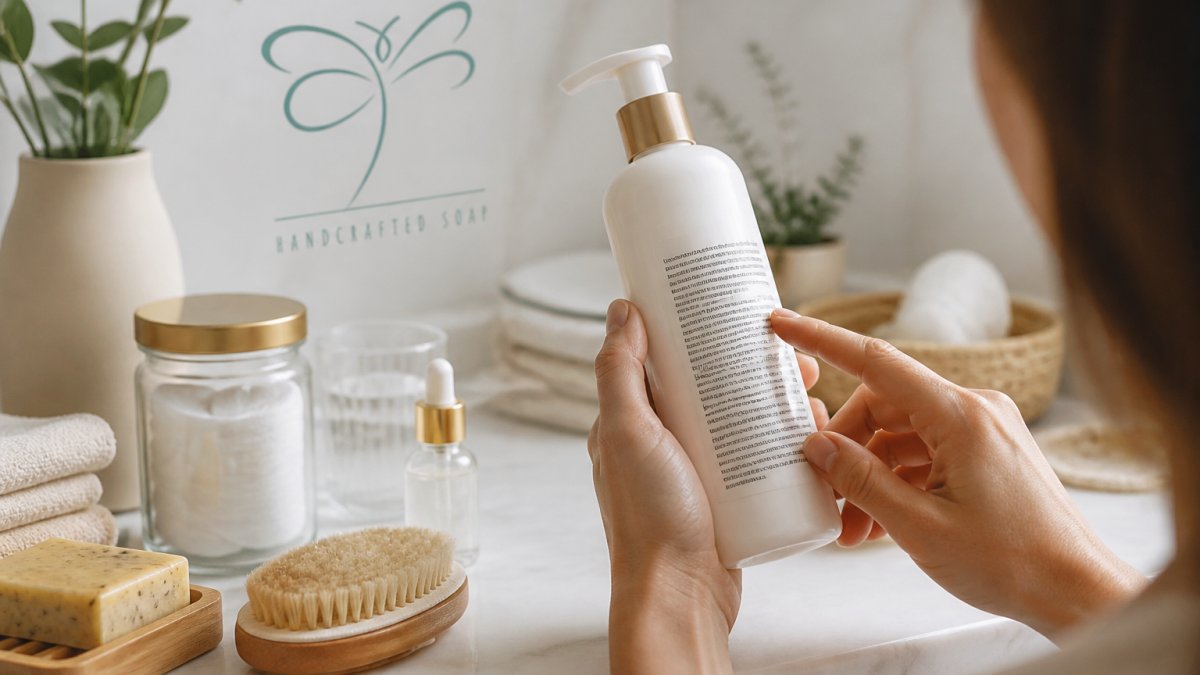
The first five ingredients tell you the most: water usually leads, oils, butters, and emulsifiers follow, and preservatives and fragrance sit near the bottom because they're used in small amounts. The tricky part is the vocabulary.
Where to Find the Ingredient List on a Body Lotion
The ingredient list is required on the back or side panel of any body lotion sold in the U.S. It's usually printed in small type under the words "Ingredients" or "Drug Facts" if the product makes a medical claim.
Federal rules from the FDA's cosmetic labeling guidance require cosmetics to list ingredients in descending order of concentration. If you can't find the list, that's a red flag.
Decoding Synonyms: Parfum, Fragrance, and Other Label Names
Fragrance is a catch-all term. It can hide dozens of individual compounds behind a single word.
Parfum is the same thing under its French name. You'll see both on U.S. labels.
Other names worth recognizing:
- Methylparaben, propylparaben, butylparaben, all parabens
- DMDM hydantoin, imidazolidinyl urea, formaldehyde-releasing preservatives
- Sodium laureth sulfate, sodium lauryl sulfate, sulfates
Body Lotion Ingredients to Avoid: A Practical Checklist
Most lists of ingredients to avoid treat every flagged name as equally dangerous. That's not how risk works: a preservative used at a fraction of a percent in a leave-on lotion differs from a harsh cleanser at high concentration in a rinse-off wash. So here's a graded list, organized by how strong the evidence actually is.
How to Read This Checklist
Three things change how much a given ingredient matters in a body lotion specifically:
- It's a leave-on product. Unlike a body wash you rinse off in seconds, lotion stays on your skin for hours, increasing contact time and absorption, especially on large areas like arms, legs, and torso.
- You apply it often and widely. Daily use over a large area means cumulative exposure, not a one-time dab.
- Skin condition changes absorption. Broken, dry, cracked, or inflamed skin absorbs more than intact skin, so the same formula can behave differently on you.
Keep those three factors in mind as you read the tiers below.
Tier 1: Established Concerns Worth Prioritizing
These are the ingredients where the concern is well-recognized and the mechanism is understood.
Formaldehyde-releasing preservatives. Names to look for include DMDM hydantoin, diazolidinyl urea, imidazolidinyl urea, quaternium-15, and bronopol.
Undisclosed fragrance. "Fragrance" and "parfum" are legal catch-all terms that can represent dozens of compounds without naming any.
Coal tar dyes and certain color additives. Look for "D&C" or "FD&C" followed by a color and number (for example, D&C Red 33).
Tier 2: Limited or Mixed Evidence, Context Matters
These get flagged constantly, but the picture is more nuanced than most lists admit.
Parabens (methylparaben, propylparaben, butylparaben, and others ending in "-paraben"). These are among the most studied cosmetic preservatives.
PEG compounds (PEG-100 stearate, polyethylene glycol, and similar). The PEG molecule itself is generally considered safe.
Sulfates (sodium lauryl sulfate, sodium laureth sulfate).
Propylene glycol. A humectant that draws moisture into the skin.
Tier 3: Contaminants to Be Aware Of, Not Ingredients to Avoid
Heavy metals like lead, mercury, arsenic, and cadmium aren't intentionally added to lotions. They show up as trace contaminants in raw materials, pigments, minerals, and botanical extracts, so you won't find them on a label. Manage this risk by choosing brands that test raw materials and finished products, and say so.
The Takeaway on This List
Don't treat every flagged name as a reason to throw a product away. Concentration, formulation, frequency, and application area all matter. The most useful habit is knowing which tier an ingredient falls into, then deciding based on your own skin and tolerance for uncertainty.
Fragrance in Body Lotion: What Parfum Hides and How to Choose
Fragrance is the single biggest wildcard in body lotion. For people with sensitive skin, it's one of the most common triggers of irritation and contact dermatitis.
Here's the practical move: choose fragrance-free over unscented when your skin is reactive. They are not the same thing.
- Fragrance-free means no fragrance has been added at all.
- Unscented often means a masking fragrance was added to cover the smell of other ingredients.
If you want scent without the mystery, look for products scented with named essential oils or botanicals instead of the generic term.
American Academy of Dermatology guidance on fragrance sensitivity
Evaluating Safety Seals, Certifications, and Product Claims
A seal on a bottle feels like a guarantee. It usually isn't. Most certifications verify one specific thing, rarely the thing shoppers assume. Understanding what each type of seal actually checks is the difference between informed trust and marketing comfort.
What Different Seals Actually Verify
Certifications fall into a few broad categories, and they are not interchangeable:
- Ingredient-level certifications review individual ingredients against a restricted-substances list. They tell you what's in the formula, but not how it was made or whether it was tested for contaminants.
- Facility and process certifications verify how and where a product is made, good manufacturing practices, organic handling, fair-labor standards. A facility seal says nothing about the ingredient list.
- Finished-product testing means the final product was tested for something specific, like microbial safety or trace contaminants. It's the most relevant to contamination concerns and the least common.
A product can carry several seals and still disclose very little about its formula. That's not a flaw in the seals, it's a flaw in assuming any single seal covers everything.
Marketing Terms With No Legal Definition
Words like "clean," "pure," "natural," "botanical," "green," and "non-toxic" have no standardized legal definition in cosmetics. A brand can use them freely, they tell you about positioning, not the formula.
"Dermatologist-tested" typically means a dermatologist was involved in some testing at some point. It does not mean the product was tested on people with sensitive skin, passed a specific protocol, or is endorsed by a dermatologist.
"Hypoallergenic" is similar: it suggests the maker tried to reduce common allergens, but there's no required standard behind the claim.
What Actually Tells You Something
When you're comparing two lotions and the seals are ambiguous, these signals are more reliable than any badge:
- A complete ingredient list in descending order, with no catch-all terms doing heavy lifting. If "fragrance" is the only scent-related entry, you know less than if individual components are named.
- Named preservatives. A label that lists its preservative system specifically is more transparent than one that hides it.
- A stated contaminant-testing practice. Brands that test for heavy metals or 1,4-dioxane and say so give you something verifiable.
How to Vet a Claim in About a Minute
When you see a seal or a claim, ask three questions:
- Who issued it? A named third-party organization is more meaningful than a brand's own badge.
- What does it cover? Ingredients, facility, finished product, or ethics, pick the one that matters for your concern.
- What does it not cover? Every seal has a scope; knowing the boundary is as important as knowing the claim.
If a brand can't answer those three questions on its packaging or website, treat the seal as decoration.
At Minerva Rae, we'd rather you evaluate our labels than trust a badge. Every product lists what's inside, so you can apply the same three questions to us that you'd apply to anyone else.
How to Check Your Current Body Lotion in 5 Steps
You can audit any body lotion in your bathroom in about two minutes:
- Flip the bottle and find the ingredient list. If there isn't one, set it aside.
- Read the first five ingredients. These make up most of the formula. Look for water, oils, and butters you recognize.
- Scan for the flagged groups. Check for parabens (names ending in "-paraben"), formaldehyde releasers ("-urea," "-hydantoin"), and PEG compounds.
- Check the fragrance line. If it says "fragrance" or "parfum" and your skin is sensitive, treat it as a question mark.
- Look for a certification or testing claim. A real seal from a recognized body adds confidence; a vague "natural" claim does not.
Conclusion
Reading body lotion labels is a skill, and like any skill, it gets easier with practice. The goal isn't to fear every long word.
If you'd rather skip the guesswork, Minerva Rae makes handcrafted soaps and body care with ingredients we're proud to list. Every product is made with intention, from the ingredients we choose to the designs we create.
Frequently Asked Questions
What are some toxic ingredients commonly found in lotions?
Common ingredients of concern in body lotions include parabens (methylparaben, propylparaben), phthalates, synthetic fragrance (parfum), formaldehyde-releasing preservatives, sulfates, PEG compounds, and propylene glycol. Some also contain coal tar, certain D&C colorants, or heavy metals like lead and mercury as contaminants. Not every ingredient affects everyone the same way, but if you have sensitive skin or want to reduce chemical exposure, these are the ones to watch for on the ingredient label.
What does fragrance or parfum mean on a lotion label?
Fragrance or parfum is a catch-all term that can represent dozens of individual scent chemicals, including phthalates used to make scents last longer. Because the specific components are not required to be listed, it is difficult to know exactly what you are applying. If you have sensitive skin or prefer to avoid undisclosed ingredients, choose products labeled fragrance-free rather than unscented, since unscented products may still contain masking fragrances.
Which ingredients should people with sensitive skin check for in body lotion?
People with sensitive skin should check for synthetic fragrance, parabens, formaldehyde-releasing preservatives, propylene glycol, and sulfates. These are among the most common triggers for skin irritation in body lotions. Also look for PEG compounds and D&C colorants. A practical step is to patch-test any new lotion on a small area of skin before applying it all over, and keep a note of which ingredients cause reactions so you can avoid them in the future.
How can I tell whether a body lotion ingredient may irritate my skin?
Start by reading the full ingredient list and comparing it against any known sensitivities you have. Ingredients like synthetic fragrance, propylene glycol, and certain preservatives are frequent irritants. Check for third-party certifications or safety seals that indicate the product has been tested for safety. When trying a new lotion, apply a small amount to your inner forearm and wait 24 hours. If you notice redness, itching, or burning, stop using it and note the ingredients for future reference.
The hardest part of clean body care isn't finding better products. It's trusting what's inside them. Minerva Rae handcrafts soaps and body care using cold process and melt and pour methods, with an intentionally curated ingredient line and personalized options for gifts and events. Explore the collection and bring a more considered ritual into your routine.