

Last Updated: November 1, 2026
Quick Summary
To layer natural soap scents well, choose a top note, a middle note and a base note, and balance them by ratio rather than by total amount. Add the blend at light trace, keep the fragrance load within each oil's published limit, and cure and dry the bar properly so the scent lasts.
- Citrus oils such as sweet orange are bright but tend to fade fastest.
- Woody and resinous oils like patchouli sit deeper and often last longer on the skin.
- Pre-blend top, middle and base notes in a small glass cup before adding them to the batter.
- Add scent at light trace rather than before lye water to limit how long volatile notes sit in heat.
- Test scent at unmolding, week 1, week 4 and week 8, recording results in a batch log.
Table of Contents
- Why Natural Soap Scents Fade and What You Can Control
- Choosing Essential Oils and Fragrance Oils by Scent Family
- Building Natural Soap Scent Combinations With Top, Middle, and Base Notes
- A Step-by-Step Method for Layering Scent in Cold-Process Soap
- How Long Soap Fragrance Lasts on Skin and How to Test It
- Layering Scent With Body Lotion, Body Oil, and Body Wash
- Troubleshooting Fading Scent and Safe Usage Rates
- Choosing Your Next Scent-Layered Bar From Minerva Rae
- Frequently Asked Questions
Why Natural Soap Scents Fade and What You Can Control
Natural soap scents fade faster than synthetic ones, and most of the reason is chemistry, so learning how to layer natural soap scents starts with understanding volatility. Essential oils are volatile, which means they evaporate (ncbi.nlm.nih.gov).
You control more than you might think. Your fragrance choice, how much you add, when you add it and how you store the finished soap all matter. The sections below walk through each one.
Here is what you can actually manage:
- Oil choice: Some essential oils hold their character longer than others.
- Fragrance load: Adding more scent is not always better. Too much can irritate skin.
- Timing: Adding scent at the right point in the process helps it stay in the bar.
Choosing Essential Oils and Fragrance Oils by Scent Family
Scent families are a useful way to sort your options when you want to layer natural soap scents in a balanced way. Citrus, mint, herbal, woody and resinous oils each behave differently.
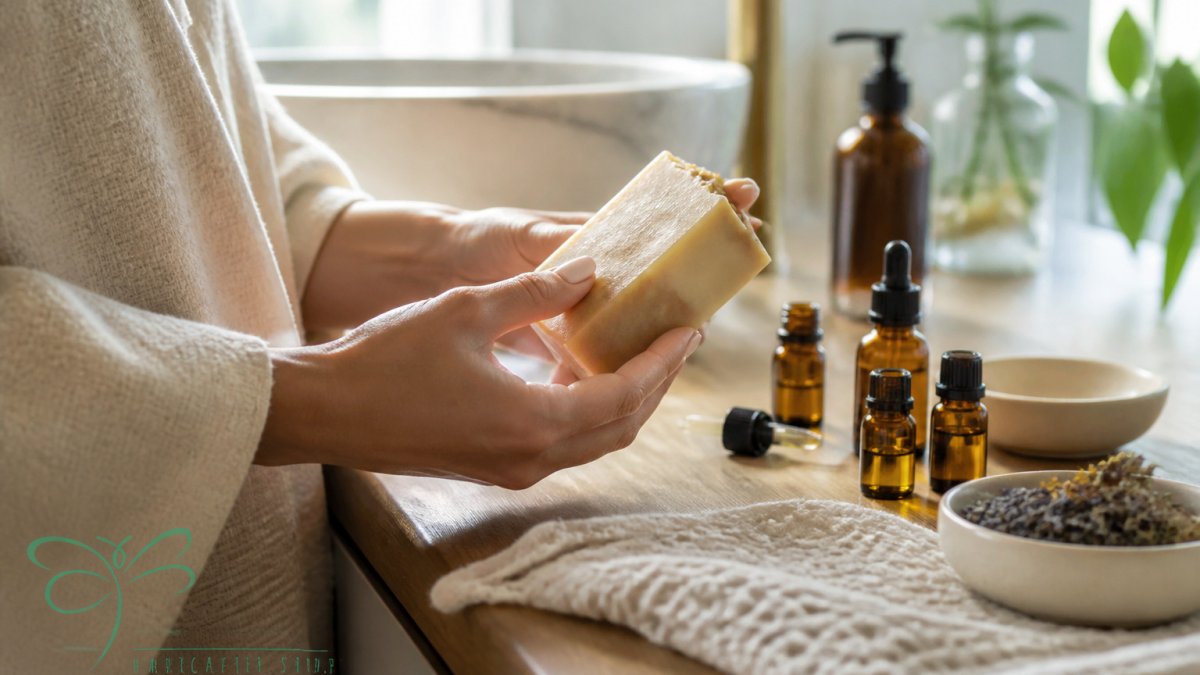
!Close-up of a woman's hands gently holding a handcrafted bar of soap beside small glass bottles of essential oils on a wooden bathroom counter in soft morning light
Our Orange Patchouli bar shows how two scent families can work together. Sweet orange gives the top notes, and patchouli grounds the blend. You can browse it here: explore the Orange Patchouli bar.

When you choose oils, keep these points in mind:
- Match the scent family to the mood you want.
- Pair a fast-fading citrus with a slower woody or resinous note.
- Check the fragrance load for your recipe before you commit.
If you are still deciding which oils suit cold process soap, our guide to Best Essential Oils for Cold Process Soap compares options. For help narrowing down scents, read How to Choose Natural Soap Scents Online.
Building Natural Soap Scent Combinations With Top, Middle, and Base Notes
Perfumers sort scents into three layers. Top notes hit first and fade quickly. Middle notes give the scent its main character. Base notes last longest and anchor the blend.
A simple two- or three-oil blend is often enough. One bright top note, one warm middle note and one deep base note covers the range.
Pairing complementary scents also helps. Peppermint with rosemary feels clean and herbal. Pine with orange feels fresh and sharp.
A Step-by-Step Method for Layering Scent in Cold-Process Soap
Layering scent in soap is not the same as layering perfume on skin. In cold process, the fragrance has to survive saponification, a weeks-long cure, and repeated wet-dry cycles in the shower. The method below treats the blend as a formulation decision first and a sensory one second, so you build a bar that still smells like something in month three.
- Set your fragrance load before you blend. Work from your recipe's oil weight, not the total batch weight. Many suppliers publish a maximum usage rate per oil that you should check individually. Write the number down, you will compare against it when you test.
- Build the blend by ratio, not by drops. Citrus and other top notes are the first to disappear, so a blend heavy in citrus will smell bright on day one and flat over time. Adjust the ratio, not just the total amount, when you want more staying power.
- Pre-blend the essential oils in a small glass cup. Combining top, middle, and base notes before they hit the batter gives you a uniform scent profile instead of pockets of one oil. This also lets you smell the blend neat and catch a clash before it is locked into a batch.
- Choose your addition point deliberately. Adding fragrance before the lye water exposes the oils to the most heat and chemical activity; adding at light trace gives you more control and is the more common approach for blends you care about. Emulsify with a few seconds of stick blending, then finish by hand to avoid accelerating trace.
- Watch for acceleration and discoloration. Some base notes, particularly certain resins and vanillin-containing absolutes, can speed trace or darken the bar. If the batter thickens within seconds of adding fragrance, you have an acceleration-prone oil; note it and either reduce its share or move your addition later next time.
- Cure, then test on a schedule. Do not judge scent at unmolding. Evaluate over several weeks, smelling the same bar each time and recording which notes remain. Cold process soap needs time to cure, and scent often reads differently early on than it does after several weeks as water evaporates and the bar hardens.
Adding Fragrance at Light Trace Versus Before Lye Water
Adding scent before the lye water means the essential oils sit in the raw oil mixture while the lye solution is prepared and cooled, exposing them to more time and, depending on your process, more heat.
Adding at light trace, when the batter has thickened just enough to leave a faint trail, is the more controlled option.
A practical middle path: warm your pre-blended essential oils gently so they are fluid, add them at light trace, and stir by hand for 30 to 60 seconds before a brief stick-blend.
A Repeatable Scent-Retention Test
You cannot improve longevity you do not measure. Use the same bar, the same nose, and the same intervals each time:
- Day 1 (unmold): Smell the cut face and record the dominant note.
- Week 1: Smell the same bar after it has sat uncovered at room temperature.
- Week 4: Note which notes have dropped out and which remain.
Record results in a simple table: batch ID, oil, load percentage, ratio, addition point, and a 1-5 scent-strength score at each interval. Two batches compared side by side will tell you more about longevity than any single batch ever will.
The steps below show the order to follow when layering scent in cold process soap, with the timing or frequency for each.
| Step | What to do | Time or frequency |
|---|---|---|
| Set fragrance load | Work from oil weight and check each oil's max usage rate | Before blending |
| Build blend by ratio | Adjust ratio toward base notes for staying power | Before blending |
| Pre-blend oils | Combine top, middle and base notes in a small glass cup | Before adding to batter |
| Choose addition point | Add at light trace, then stir by hand | At light trace |
| Watch for acceleration | Reduce or move addition if batter thickens fast | During mixing |
| Cure and test | Evaluate scent over several weeks | Unmold, week 1, week 4, week 8 |
How Long Soap Fragrance Lasts on Skin and How to Test It
Scent on a finished bar fades over time, and it fades faster on skin than in a jar. Expect the scent to be strongest during use and to soften as the bar dries.
To test longevity, try this simple method:
- Use a new bar for three days in a row.
- Smell the bar after drying each day.
- Note which scent notes remain after 24 hours.
Curing also matters. Cold process soap needs time to harden, and well-cured bars tend to hold their character better. For more on why curing matters, read Why Does Cold Process Soap Need to Cure?.
Layering Scent With Body Lotion, Body Oil, and Body Wash
You can extend a scent beyond the soap. Some people choose a matching body lotion or body oil after washing to extend the scent. A body wash in a related scent family can reinforce the same notes.
Stick to scents from the same family so the layers blend rather than clash. Light oils hold a scent on hydrated skin better than a dry surface does.
Troubleshooting Fading Scent and Safe Usage Rates
When a bar loses its scent, the cause is usually one of four things: the blend was top-note-heavy, the fragrance load was too low for the recipe, the oils oxidized during cure, or the bar is being stored wet. Distinguishing these matters because each has a different fix, and adding more oil is rarely the right one.
Diagnosing the Cause
- Top-note-heavy blend: The bar smells bright at unmold and flat by week four. Consider adjusting the ratio toward base notes rather than raising the total load.
- Load too low for the recipe: The scent was faint from day one. Check your percentage against the oil weight and compare with a batch you know performed.
- Oxidation during cure: The scent smells off, waxy, or "old" rather than simply weak. Citrus and other high-limonene oils are prone to this; store cured bars cool, dark, and wrapped to slow it.
Safe Usage Rates and Skin-Safety Checks
Fragrance load is a safety decision before it is a longevity decision. Essential oils are concentrated plant chemistry, and some, including citrus oils, cinnamon, clove, and certain mints, are well-known sensitizers. A bar that smells stronger because you doubled the load may also be a bar that irritates skin.
Practical checks:
- Follow supplier-published maximum usage rates for each oil. These are set per oil and per product type; do not assume one number applies to every essential oil in your blend.
- Respect the total blend, not just each oil. A blend of five oils each at its individual maximum can still exceed a sensible total load for a leave-on-adjacent product like soap.
- Patch test new blends. Apply a small amount of diluted blend to the inner forearm and wait 24 to 48 hours before committing a full batch.
Natural Fixatives and Their Limits
Some soapmakers add clays, resins, or small amounts of a heavier base-note oil to help anchor lighter notes. These can help a blend read as fuller and can slow the perception of fading, but no natural additive guarantees lasting scent in cold process soap. Treat fixatives as one variable in the blend, test them the same way you test everything else, and be skeptical of any claim that a single ingredient will make a citrus bar smell like citrus in month six.
When to Reformulate Versus When to Adjust
If a batch fades but the blend ratio and load were sound, adjust storage and cure time first. If two or three batches with the same blend fade the same way, reformulate, shift the ratio toward base notes, change the addition point to light trace, or swap a fast-fading oil for a slower one. Keep the batch log from the method section so you can tell which change actually moved the result.
Choosing Your Next Scent-Layered Bar From Minerva Rae
Layering scent well comes down to choosing the right notes, timing the blend, and caring for the bar after it cures. Minerva Rae offers handcrafted bars made with a focus on lasting quality and a refined sensory experience. Start with one scent family you enjoy, follow the method above, and build from there.
Frequently Asked Questions
How long does soap fragrance last on skin?
Most soap scent fades within a few minutes to a few hours on skin, because soap is rinsed off almost immediately. Scent that lasts longer usually comes from a higher fragrance load, a base note that is heavier and slower to evaporate, and a fixative such as patchouli or a resinous oil. Rinse-off products will never match the staying power of a leave-on lotion or perfume oil, so layering a matching body lotion or body oil after the shower gives the scent its best chance to linger. Test your results by smelling your wrist at intervals after washing to see how the scent develops.
Can I add essential oils to melt and pour soap?
Yes, you can add essential oils to melt and pour soap, but keep the amount modest and follow the usage rate the oil supplier recommends. Add the fragrance after the base has melted and cooled slightly, stir gently to avoid bubbles, and pour before it begins to set. Some oils, especially citrus oils, can fade or change in melt and pour bases, so test a small batch first. Store finished bars in a sealed container away from direct sunlight to protect the scent.
Which scent notes work well together when layering soap?
A reliable combination pairs one top note, one middle note, and one base note from the same or a compatible family. Citrus such as sweet orange or bergamot works as a bright top note, lavender or rosemary as a herbaceous middle note, and patchouli, cedarwood, or vetiver as a grounding base. Two- or three-oil blends are usually easier to balance than complex recipes with many ingredients. Keep the total fragrance load within the range that suits your recipe, and confirm the appropriate figure with your supplier.
Should I use matching or complementary scents with natural soap?
Complementary scents are usually the better choice. Matching a soap scent exactly with a lotion or body oil can make the fragrance feel heavy, while a complementary pairing, such as a citrus soap with a lightly woody body oil, creates depth without overpowering the skin. If you want a cohesive effect, choose products that share one dominant note and let the rest of the blend contrast. Always patch test a new combination on a small area of skin before using it all over, especially if you have sensitive or dry skin.
