

Table of Contents
- What Rosacea Does to Your Skin Barrier
- Does Natural Soap Help With Rosacea Symptoms? What It Can and Cannot Do
- The Best Soap Ingredients for Rosacea (and What to Avoid)
- pH-Balanced Soap vs. Traditional Soap: Why It Matters for Rosacea
- A Skincare Routine for Rosacea-Prone Skin
- How to Prevent Dry Skin in Winter Without Triggering Rosacea
- Common Mistakes When Switching to Natural Soap for Rosacea
- Frequently Asked Questions
Last Updated: September 26, 2026
What Rosacea Does to Your Skin Barrier
Rosacea is a chronic inflammatory condition that weakens the skin barrier and makes the face reactive to heat, friction, and harsh cleansing, which is why so many people ask does natural soap help with rosacea symptoms. Whether natural soap helps with rosacea symptoms comes down to what a bar does to your barrier.
Does Natural Soap Help With Rosacea Symptoms? What It Can and Cannot Do
Natural soap can help with rosacea symptoms by cleansing without stripping the skin barrier, but it cannot treat the underlying condition.
Where Natural Soap Helps: Redness Reduction and Gentle Cleansing
The clearest benefit is gentleness. A well-formulated natural bar cleans without harsh surfactants that leave skin tight, dry, and flushed, so skin holds onto moisture and shows less irritation over time.
Where Natural Soap Falls Short: Flare-Up Triggers and Medical Treatment
Natural soap will not shrink visible blood vessels, stop a flare, or replace a prescribed topical. "Natural" is not a synonym for "gentle": essential oils, botanical extracts, and exfoliating additives can all trigger reactions, and a bar can be entirely plant-based and still too much for your face.
The Best Soap Ingredients for Rosacea (and What to Avoid)
The best soap ingredients for rosacea are unscented, non-comedogenic, and built on moisturizing oils rather than stripping surfactants. The ingredient list tells you more than the front label.
Ingredients worth seeking out:
- Colloidal oats and oatmeal for soothing and light exfoliation
- Shea butter, goat milk, and tallow for moisturizing and barrier support
- Chamomile, calendula, and green tea extract for their calming, antioxidant properties
- Aloe vera and raw honey for hydration and gentle antibacterial action
- Brazilian clay for color without synthetic dyes
Ingredients to Avoid: Synthetic Fragrances, Drying Alcohols, and Harsh Surfactants
Synthetic fragrances are the most common culprit: fragrance is a leading cause of irritation generally, and rosacea-prone skin reacts faster than most. Drying alcohols and harsh surfactants strip the lipid barrier, leaving skin tight and prone to flushing. Tea tree and citrus oils are natural but common irritants on reactive skin.
pH-Balanced Soap vs. Traditional Soap: Why It Matters for Rosacea
pH-balanced soap keeps the skin's acid mantle near its natural level, while traditional lye soap runs alkaline and disrupts that balance. This overlooked factor is where many "natural" bars quietly fail.
What actually changes the pH of a bar:
- True lye soap (cold-process or hot-process): alkaline by nature, typically pH 9 to 10. Gentle oils do not change the chemistry.
- Syndet bars (synthetic detergent bars): formulated with milder surfactants and buffered to a lower pH, often in the 5.5 to 7 range. "Synthetic" here refers to the surfactant, not to harshness, many syndets are far gentler than lye soap.
- Soap with added acidic ingredients: citric acid, lactic acid, or certain fruit extracts can pull the finished pH down somewhat, but they rarely bring a true lye bar all the way to skin-friendly territory.
- "pH-balanced" on a label: a marketing term, not a regulated one. It means nothing unless the brand publishes an actual number.
How to Read pH Claims Without a Lab Kit
You do not need a meter to make a reasonable guess:
- Ask the brand for a number. Reputable makers who test batches can usually give a pH range. If they cannot, treat the claim as unverified.
- pH test strips (sold for aquariums or kombucha) are inexpensive and give a rough read on a dissolved sliver of bar, separating a pH 6 syndet from a pH 10 lye soap.
- Squeaky-clean feel after rinsing often signals an alkaline bar stripping the barrier. Skin that feels soft and slightly moisturized after patting dry is the better outcome.
- Lather quality is not a proxy. Big, bubbly lather says nothing about pH; some of the gentlest bars lather modestly.
A Skincare Routine for Rosacea-Prone Skin
A rosacea-friendly routine is short, lukewarm, and fragrance-free: cleanse gently, moisturize while skin is damp, and protect the barrier daily. Fewer steps done consistently beat a long routine done aggressively.
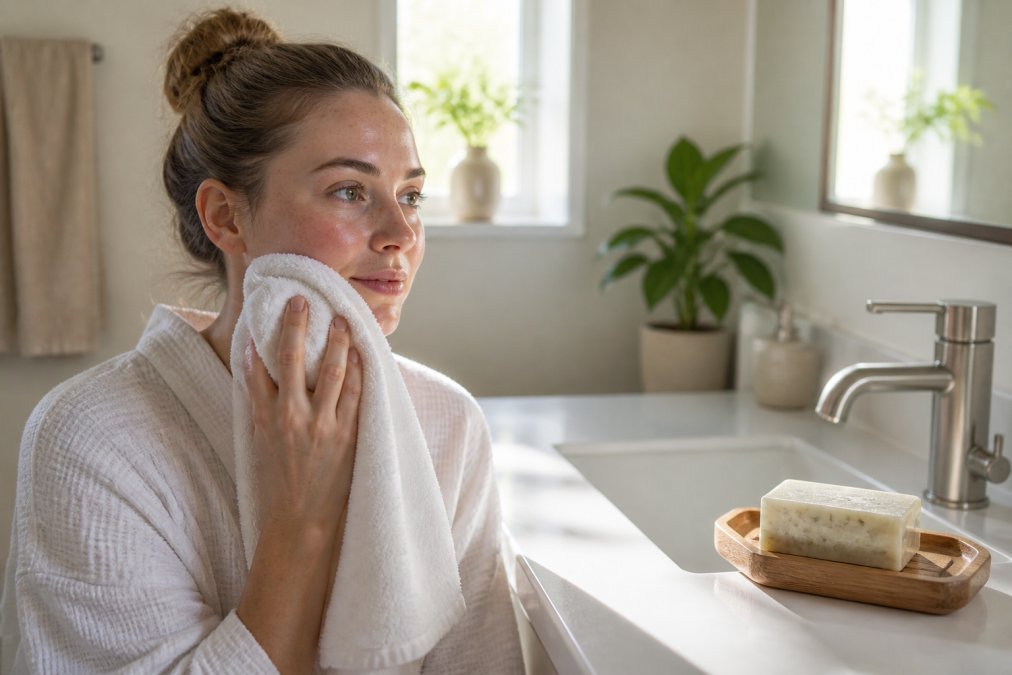
A simple sequence that works for most reactive skin:
- Cleanse once or twice daily with lukewarm water and a gentle, unscented bar. Use your fingertips, never a washcloth.
- Pat dry with a soft towel. Do not rub.
- Moisturize within a minute, while skin is still slightly damp, to lock in hydration.
- Apply sunscreen every morning. Sun exposure is a well-documented rosacea trigger.
- Patch test any new product before it touches your whole face.
Patch Testing Protocol: How to Introduce a New Bar Safely
Patch testing reveals whether a new bar suits your skin before a full-face reaction teaches you the hard way. Follow this protocol every time you switch products.
-
Wash a small area behind your ear or on your inner forearm with the new bar
-
Rinse and pat dry, then wait 24 hours
-
Check for redness, itching, burning, or bumps
-
If clear, repeat on a small patch of jawline for another 24 hours
-
If still clear, introduce the bar to your full face, once daily at first
-
Test one new product at a time. Starting a new bar and moisturizer the same day tells you nothing about which caused a reaction.
-
Do not test on broken or flaring skin. Wait until a flare settles; inflamed skin will almost always read as a reaction.
-
Use your normal water temperature and routine. A patch test in a hot shower is not a fair test.
-
Photograph the patch area at the start and at 24 and 48 hours. Rosacea redness is easy to misremember.
-
Watch for delayed reactions. Contact dermatitis can build over days. A patch clear at 24 hours but itchy at 72 counts as a fail.
Layering Natural Soap With Prescription Topicals and Sunscreen
Most people asking whether natural soap helps with rosacea symptoms already use something else, metronidazole gel, azelaic acid, ivermectin cream, a sodium sulfacetamide wash, or a beta-blocker for flushing. The soap is not competing with those treatments; the question is how to sequence them without irritation or pilling.
A workable order for most people:
- Cleanse with the natural bar and lukewarm water.
- Wait 2 to 3 minutes until skin is fully dry. Damp skin increases penetration of actives and can amplify stinging.
- Apply prescription topical to the affected areas, following your dermatologist's instructions.
- Wait another 2 to 3 minutes before the next layer.
- Moisturize to buffer and support the barrier.
- Sunscreen last in the morning, as the final step.
A few ingredient interactions worth knowing about:
- Essential oils and prescription actives. Citrus, tea tree, peppermint, and eucalyptus can sting skin sensitized by a retinoid, azelaic acid, or benzoyl peroxide. If your topical already stings mildly, a scented bar can push it into a full flare.
- Exfoliating additives and acids. Oatmeal and clay are gentle; ground seeds, salt, sugar scrubs, and bars with salicylic or glycolic acid are not, and should not be layered with a prescription exfoliant or retinoid the same day.
- Sunscreen and heavy butters. Shea butter and tallow are excellent barrier ingredients, but a thick layer under mineral sunscreen can cause streaking or pilling. Use a lighter morning moisturizer and save the richer bar for evening.
- Antibacterial bars and prescription topicals. Antibacterial soaps disrupt the microbiome and dry the barrier, working against most rosacea treatment plans. Skip them.
How to Prevent Dry Skin in Winter Without Triggering Rosacea
To prevent dry skin in winter without triggering rosacea, reduce cleansing frequency and lean on moisturizer and barrier support. Cold air, indoor heating, and hot showers pull moisture from skin, and rosacea-prone skin feels that loss faster than most.
A few adjustments that help through the colder months:
- Drop to one cleanse a day if your skin tolerates it, using lukewarm water only in the morning
- Switch to a richer, unscented bar and moisturize immediately after patting dry
- Keep shower and wash water lukewarm, never hot
- Add a humidifier to rooms you spend the most time in
- Avoid wool and rough fabrics directly against the face
Common Mistakes When Switching to Natural Soap for Rosacea
The most common mistake is treating "natural" as a guarantee of gentleness and skipping the patch test. A close second is switching everything at once, making it impossible to tell what helped and what caused a reaction.
Other missteps worth avoiding:
- Chasing fragrance. A beautiful scent is not worth a flare; unscented bars are the safer start for reactive skin.
- Over-cleansing. Twice a day is plenty. More cleansing rarely means cleaner skin, just a more depleted barrier.
- Expecting soap to replace treatment. If you use a prescription topical, soap supports that plan rather than substituting for it.
- Judging a bar in one wash. Give it a week of consistent, gentle use before deciding.
- Ignoring ingredient interactions. Layering a new bar with an exfoliating acid or retinoid can overwhelm skin that would tolerate either alone.
Frequently Asked Questions
What type of soap is best for people with rosacea?
The best soap for rosacea is fragrance-free, pH-balanced, and made without drying alcohols or harsh surfactants. Look for bars built on gentle ingredients like tallow, goat milk, shea butter, or olive oil, which cleanse without stripping the lipid barrier. An unscented bar such as Tallow & Goat Milk ($12.00) is a practical starting point because it skips added fragrance entirely, one of the most common triggers for redness and irritation in rosacea-prone skin.
Can switching to natural soap reduce rosacea flare-ups?
Switching can reduce flare-ups caused by cleansing, but it will not eliminate rosacea itself. Rosacea involves vascular dilation and inflammation that a cleanser cannot resolve. What a gentler bar can do is stop the daily irritation that keeps skin reactive: fewer synthetic fragrances, less barrier damage, and less dryness. Many people notice calmer skin within a few weeks, but prescription topical treatment remains the standard for controlling the condition.
Are there specific ingredients to avoid in soap if you have rosacea?
Avoid synthetic fragrances, drying alcohols, and strong surfactants such as sodium lauryl sulfate. Skip bars with essential oils known to irritate, including citrus, peppermint, eucalyptus, and tea tree oil at high concentrations. Also watch for exfoliating additives like coarse oatmeal or salt, which can aggravate already-reactive skin. An unscented, short-ingredient-list bar gives you the fewest possible triggers to react to.
How does natural soap differ from commercial cleansers for sensitive skin?
Traditional commercial bars are often formulated at a high pH, which disrupts the skin's acid mantle and leaves the lipid barrier weaker. Many also rely on synthetic detergents and fragrance blends. Natural handmade soap made with nourishing fats and oils can be gentler, particularly when it is unscented and pH-balanced. The key difference is not the word natural on the label, but the actual ingredient list and how the bar is formulated.