

Table of Contents
- Quick Comparison: Best Natural Soap for Combination Skin 2026
- How to Identify Combination Skin
- Natural Soap Ingredients for Combination Skin
- Top 5 Natural Soaps for Combination Skin
- How to Prevent Dry Skin in Winter
- Seasonal Adjustments and Ingredient Interactions
- Sustainability and Packaging Impact
- Conclusion
- Frequently Asked Questions
Last Updated: September 18, 2026
Quick Comparison: Best Natural Soap for Combination Skin 2026
The best natural soap for combination skin in 2026 cleanses an oily T-zone without stripping drier cheeks and jawline. At Minerva Rae, every bar is built around that tension.
Quick Picks:
- Best Overall: Charcoal & Tea Tree ($12.00) for oily, blemish-prone T-zones
- Best for Dry Patches: Tallow & Goat Milk ($12.00), unscented and fragrance-free
- Best for Sensitive Skin: Old Fashioned Tallow & Oatmeal ($12.00) with finely ground oatmeal
- Best for Dullness: Turmeric & Honey ($12.00) with citrus essential oils
- Best for Gentle Exfoliation: Cocoa Shea ($12.00) with African Black Soap and oatmeal
| Soap | Price | Key Ingredients | Best For |
|---|---|---|---|
| Charcoal & Tea Tree | $12.00 | Activated charcoal, kaolin clay, tea tree oil | Oily T-zone, blemish-prone skin |
| Tallow & Goat Milk | $12.00 | Tallow, goat milk, olive oil | Sensitive or dry skin, unscented |
| Old Fashioned Tallow & Oatmeal | $12.00 | Tallow, oatmeal, shea butter | Gentle daily exfoliation |
| Turmeric & Honey | $12.00 | Turmeric, honey, orange oil | Dullness, uneven tone |
| Cocoa Shea | $12.00 | African Black Soap, shea, cocoa butter | Deep detox plus moisture |
How to Identify Combination Skin
Combination skin means the T-zone (forehead, nose, chin) produces excess sebum while the cheeks and jawline stay normal to dry. Your nose likely shines by mid-afternoon while your cheeks feel tight after cleansing.

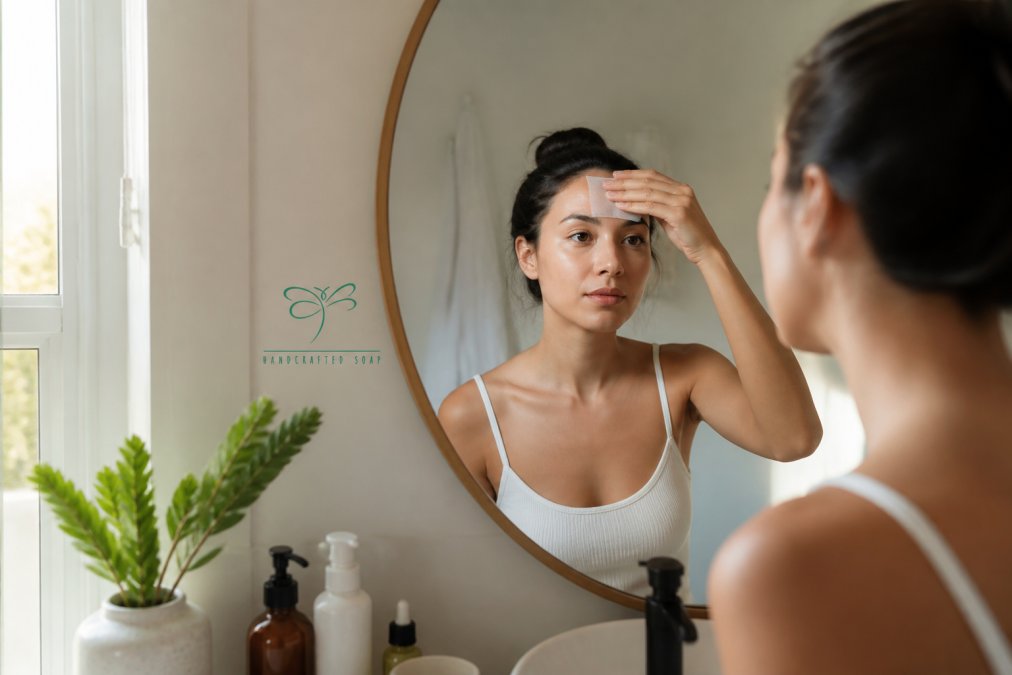
The T-Zone Test
Wash with a gentle, fragrance-free bar, wait one hour without applying anything, then press a blotting sheet across your forehead, nose, cheeks, and jaw.
- Oil on the T-zone only: combination skin
- Oil everywhere: oily skin
- No oil anywhere, tightness on cheeks: dry skin
Natural Soap Ingredients for Combination Skin
The right bar does two jobs: oil-balancing for the T-zone and lipid replenishment for the cheeks. Look for cold-pressed oils, glycerin-rich bases, and non-comedogenic botanical extracts.
Ingredients to Look For
- Kaolin clay: draws out pore congestion without over-drying
- Glycerin and shea butter: humectants and emollients that support the moisture barrier
- Cold-pressed olive and coconut oils: gentle cleansing with essential fatty acids intact
- Colloidal oats and silk fibers: soothing agents that reduce tightness
- Essential oils like tea tree and rosemary: natural clarifying benefits
Ingredients to Avoid
- Synthetic surfactants and sulfates: strip the moisture barrier and trigger rebound oil
- Parabens and synthetic dyes: common irritants for reactive skin
- High-fragrance formulas: can worsen redness on already-dry cheeks
Top 5 Natural Soaps for Combination Skin
Every bar below is handcrafted at $12.00 for approximately 4.5 oz, made with natural oils, butters, and tallows rather than synthetic detergents.
How to Prevent Dry Skin in Winter
Winter is the hardest season for combination skin because the two zones respond to cold in opposite directions. Cold outdoor air holds less moisture, and indoor heating lowers humidity further, accelerating trans-epidermal water loss (TEWL). But sebum production does not shut off in the T-zone the way it does on the cheeks. The result: flaky at the jawline, still shiny across the forehead by mid-afternoon.
Why Combination Skin Reacts Differently
The cheeks and jawline have fewer sebaceous glands and a thinner lipid barrier than the T-zone, so when humidity drops they lose water faster. Meanwhile the T-zone keeps producing sebum, so heavy winter creams that rescue the cheeks can clog the nose and forehead. The fix is a lighter cleanse plus faster lipid replenishment, applied zone by zone.
A Winter Rotation That Works
- Switch your bar, not your routine. Move from a clarifying charcoal or clay bar to an unscented, butter-rich bar such as Tallow & Goat Milk when indoor heating kicks on. Keep the same once-daily cleanse so the T-zone does not overproduce oil.
- Lower your water temperature. Hot showers dissolve surface oils faster than warm water. Lukewarm water alone often reduces post-shower tightness on the cheeks within a week.
- Pat, do not rub. Friction on damp skin damages the lipid barrier. Press a soft towel against the face and move on.
- Moisturize within three minutes. Apply while skin is still damp so humectants like glycerin pull water into the upper layers before it evaporates. This is the highest-impact winter habit.
- Cut exfoliation to two or three sessions per week. Oatmeal and clay bars are gentle, but daily use on dry cheeks causes micro-irritation, redness, and rebound oil.
- Run a humidifier in the bedroom. Raising overnight humidity reduces TEWL while you sleep, which is when the barrier does most of its repair work.
Zone-by-Zone Moisturizing
Instead of one cream for the whole face, apply a richer butter or balm to the cheeks and jawline and a lighter gel or lotion to the forehead, nose, and chin. Combination skin does not need two soaps, it needs one gentle bar and a moisturizer strategy that respects the difference between zones.
What to Watch For
If your cheeks sting when you apply moisturizer, your barrier is already compromised. Drop exfoliating bars for one week, use only the unscented bar and a fragrance-free moisturizer, and reintroduce actives slowly. If the T-zone stays congested through winter despite a gentle routine, your bar is too rich for that zone, not that you need a stronger cleanser.
Seasonal Adjustments and Ingredient Interactions
Your soap should change with the calendar. The same bar that works in July can leave your cheeks tight by December.
Sustainability and Packaging Impact
Most natural-soap guides mention plastic-free packaging in a single sentence and move on. That is a missed opportunity: for combination skin, the sustainability case for bar soap is not just environmental but functional. A bar that is concentrated, plastic-free, and free of synthetic fragrance is also less likely to trigger the reactive dryness combination skin is prone to.
Why Bar Soap Wins on Packaging
A 4.5 oz bar of cold-process soap delivers roughly the same number of washes as a 16 oz bottle of body wash, but ships without a plastic pump, laminated tube, or the water weight that makes bottled cleansers costly to transport. Concentrated bars mean fewer trucks, lower shipping emissions per wash, and no microplastic shedding from synthetic exfoliants.
The Questions Worth Asking a Maker
Instead of vague "is this sustainable?" claims, ask specific, checkable questions:
- Are the oils cold-pressed and traceable? Cold-pressing preserves the fatty acids that make olive, coconut, and castor oils useful for the moisture barrier. Refined oils lose some of that.
- Is the palm oil responsibly sourced or omitted entirely? Palm-free formulations avoid the deforestation concerns that come with conventional palm. If palm is used, look for Roundtable on Sustainable Palm Oil (RSPO) certification.
- Is the packaging plastic-free or refillable? Paper wrap, compostable film, and refillable tins all beat a plastic sleeve. A bar shipped in a coated box is not automatically plastic-free, coatings matter.
- Is the bar cruelty-free? Look for a Leaping Bunny certification or an equivalent third-party verification rather than a self-declared claim.
- How long does the bar last? Longevity is a sustainability metric. A bar that dissolves in two weeks uses more packaging per wash than one that lasts six.
Storage Changes the Math
A bar's environmental footprint is partly determined by how you store it. Sitting in a puddle of water on a flat dish, a natural bar can lose a third of its mass to dissolution. A draining dish that lets air circulate around all sides keeps the bar firm and extends its life by weeks, doing more for the sustainability case than any marketing claim on the label.
Where Natural Soap Still Falls Short
It is worth being honest about the trade-offs. Cold-process soap uses sodium hydroxide, which is energy-intensive to produce, and small-batch makers often ship in quantities less carbon-efficient per unit than bulk manufacturing. Essential oils, while natural, are resource-intensive to distill. Bar soap is not perfectly sustainable, it is meaningfully better than bottled alternatives on packaging, transport, and microplastic pollution, and the remaining footprint is worth scrutinizing.
Conclusion
The best natural soap for combination skin in 2026 treats your T-zone and cheeks as two different problems in a single wash. Start with Charcoal & Tea Tree if oil and congestion lead your concerns, or Tallow & Goat Milk if sensitivity and dryness do. Both are $12.00, handcrafted in small batches, and free from synthetic fragrances, dyes, and harsh detergents.
Frequently Asked Questions
What type of soap is best for combination skin?
For combination skin, look for a gentle, pH-balanced natural soap that cleanses without stripping. Bars made with nourishing oils like olive, coconut, and castor, plus soothing ingredients such as kaolin clay, shea butter, or goat milk, help balance oily T-zones and dry cheeks. Avoid harsh sulfates and synthetic fragrances. Minerva Rae's Tallow & Goat Milk is unscented and ideal for sensitive combination skin, while Charcoal & Tea Tree targets oily areas.
What ingredients should I look for in natural soap for combination skin?
Seek out natural soap ingredients for combination skin like cold-pressed oils (olive, coconut, castor), shea butter, cocoa butter, kaolin clay, activated charcoal, colloidal oats, and goat milk. These provide gentle cleansing, moisture retention, and soothing without clogging pores. Also look for glycerin-rich formulas, essential oils (tea tree, rosemary, peppermint), and silk fibers for a luxurious lather. Avoid sulfates, parabens, and synthetic dyes.
How does cold process soap benefit combination skin?
Cold process soap retains natural glycerin, a humectant that draws moisture to the skin, which helps prevent dryness on cheeks while gently cleansing oily T-zones. The slow saponification process preserves beneficial oils and butters, creating a milder bar with a creamy lather. Many Minerva Rae soaps, such as Turmeric & Honey and Cocoa Shea, are made using this method, offering a balanced clean without disrupting the skin microbiome.
Can natural soap help balance oily T-zones and dry cheeks?
Yes, when formulated with the right ingredients. Natural soaps that contain oil-absorbing clays like kaolin or charcoal can help manage excess sebum in the T-zone, while emollients such as shea butter and tallow nourish dry cheeks. For example, Minerva Rae's Charcoal & Tea Tree uses activated charcoal and kaolin clay to detoxify pores, while its tallow and shea butter base preserves the moisture barrier, making it suitable for combination skin.
How often should I wash my face if I have combination skin?
Wash your face twice daily, morning and night, using a gentle natural soap like Minerva Rae's Tallow & Goat Milk or Old Fashioned Tallow & Oatmeal. Over-washing can strip natural oils and trigger more sebum production. If your skin feels tight after cleansing, reduce to once daily and follow with a light moisturizer. Always pat dry and avoid hot water, which can worsen dryness on cheeks.
Combination skin is stubborn, but it is not complicated once you stop treating it like oily skin or dry skin alone. Minerva Rae builds handcrafted bars around exactly that balance, using cold process and melt and pour methods, natural oils and butters, and intentionally curated ingredients that cleanse without stripping. Explore the collection and find the bar that fits your skin this season.