

Table of Contents
- What Makes Goat Milk Soap Different for Facial Skin
- Goat Milk Soap for Acne: What the Evidence Says
- How to Use Goat Milk Soap on Face Without Irritation
- Goat Milk Soap Side Effects and Who Should Skip It
- Is Goat Milk Soap Good for Sensitive Skin and Dryness?
- How Goat Milk Soap Compares to Regular Bar Soap
- Storing Your Facial Bar So It Lasts
- Conclusion
- Frequently Asked Questions
Last Updated: September 16, 2026
What Makes Goat Milk Soap Different for Facial Skin
Is goat milk soap good for face care? For many with dry or reactive skin, yes, the reason is chemistry, not marketing. Here is what the research supports and how to use a goat milk bar without irritation.

Goat milk soap is a cleansing bar made with goat milk as a primary liquid ingredient, introducing naturally occurring lactic acid, fatty acids, and vitamins. That distinguishes it from a standard detergent bar, which relies on synthetic surfactants and often depletes the skin barrier.
The short answer: goat milk soap suits dry, sensitive, and mature facial skin well, but not every face. Below: how it interacts with the lipid barrier, what it means for acne-prone skin, and the routine that keeps it gentle.
Fatty Acids, Lactic Acid, and the Lipid Barrier
The lipid barrier is the outermost layer of oils and ceramides that holds moisture in and keeps irritants out. When it thins, skin feels tight, flakes, and reacts to products it previously tolerated.
Goat milk contributes fatty acids that support this barrier, plus lactic acid, a gentle alpha-hydroxy acid that loosens the bonds between dead skin cells so they shed evenly instead of building up. That mild exfoliation improves texture over time without the sting of a stronger peel.
The benefit is cumulative: a single wash will not transform your skin, and texture and hydration changes show up after several weeks of consistent use.
pH and the Skin Microbiome
True soap, including most goat milk bars, sits on the alkaline side of the scale, higher than skin's natural acidic surface. That shift can disturb the skin microbiome, the organisms that help defend against irritation.
Cold process makers can offset this somewhat through formulation and a full cure, but no true soap is pH-balanced like a synthetic cleanser. If your skin is highly reactive, understand this trade-off before switching.
Goat Milk Soap for Acne: What the Evidence Says
Goat milk soap for acne is often marketed as a solution, and that claim deserves scrutiny. No large randomized controlled trial establishes it as an acne treatment, and no dermatology guideline lists it as one. What exists is a mechanistic case, anecdotal reporting, and trade-offs that determine whether it helps or hurts.
The case for it rests on three mechanisms. First, lactic acid, naturally present in goat milk, is an alpha-hydroxy acid that loosens the bonds between dead corneocytes, helping keep the follicular opening clear. Second, cold process goat milk bars retain glycerin, a humectant that pulls water into the stratum corneum, so skin is less likely to rebound with excess oil after a stripped barrier. Third, most handcrafted bars are free of sodium lauryl sulfate and other high-foaming anionic surfactants, the ingredients most often implicated in the tight, reactive post-wash feeling that drives over-moisturizing.
The case against it is equally concrete. True soap, including goat milk soap, is alkaline, typically pH 9 to 10, while healthy facial skin sits near pH 4.5 to 5.5. That alkaline shift temporarily raises skin pH, and elevated surface pH is associated with increased Cutibacterium acnes activity and compromised barrier recovery.
How to Use Goat Milk Soap on Face Without Irritation
Using goat milk soap on your face without irritation comes down to four habits: lukewarm water, short contact time, gentle hands, and immediate moisturizing. Skip one and even a mild bar can leave skin uncomfortable.
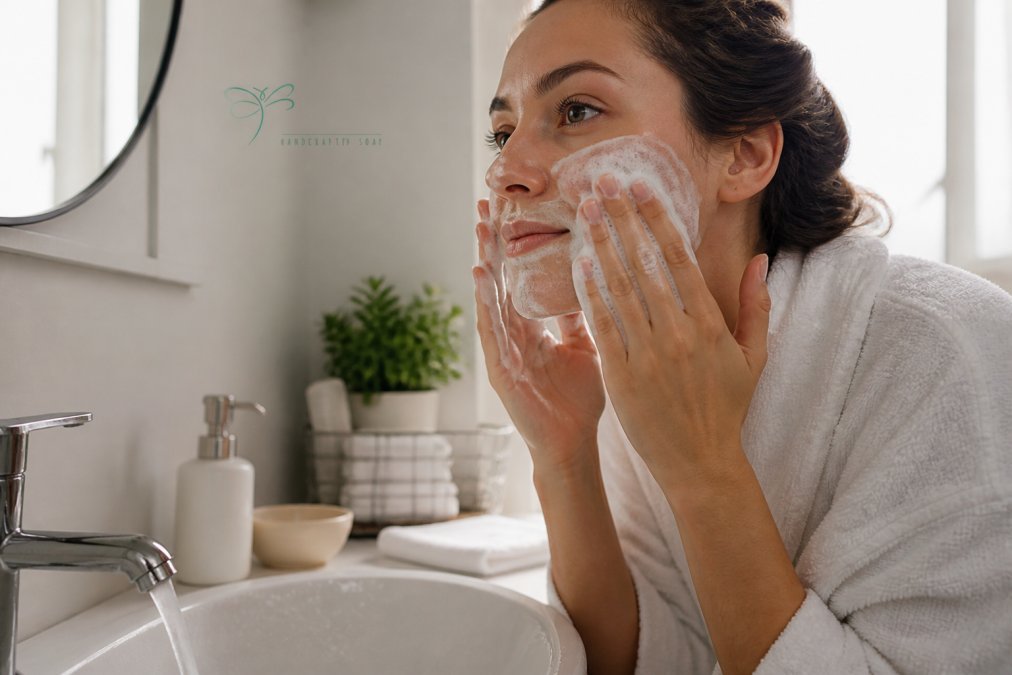
- Wet your face with lukewarm water, never hot.
- Rub the bar between damp hands until you have a soft lather.
- Apply the lather with fingertips, avoiding the eye area.
- Limit contact to about 20 to 30 seconds.
- Rinse thoroughly and pat dry with a clean towel.
- Apply moisturizer within one minute, while skin is still slightly damp.
Goat Milk Soap Side Effects and Who Should Skip It
Goat milk soap side effects are usually mild and predictable: tightness, redness, or stinging right after washing. These typically point to over-cleansing or a bar too alkaline for your skin, not an allergy.
- You have a diagnosed milk protein allergy.
- Your skin is actively inflamed, cracked, or oozing.
- You are using prescription retinoids or acids that already sensitize skin.
- Your dermatologist has directed you to a specific pH-balanced cleanser.
Is Goat Milk Soap Good for Sensitive Skin and Dryness?
For sensitive skin and dryness, goat milk soap is one of the better true-soap options, but the reason is more specific than 'it's gentle,' and the pH question is the one most guides skip.
How to Layer Goat Milk Soap With Actives
This is where sensitive-skin routines succeed or fail. If you use retinoids, vitamin C, or exfoliating acids, the order and timing of your goat milk wash matters.
- Retinoids (tretinoin, adapalene, retinol): Apply at night on dry, fully rinsed skin. If you wash with an alkaline goat milk bar immediately before, wait 10 to 15 minutes for surface pH to drift back down before applying the retinoid, applying an acid-formulated active onto alkaline skin increases the chance of stinging and peeling. Many users do better washing with the goat milk bar in the morning and using a pH-balanced cleanser on retinoid nights.
- Vitamin C (L-ascorbic acid): Apply in the morning on clean skin. Because L-ascorbic acid is most effective at low pH, washing with an alkaline bar right before can blunt its performance. Rinse thoroughly, wait a few minutes, then apply.
- Exfoliating acids (AHA/BHA): Do not stack a lactic-acid-containing goat milk bar with a separate acid toner or peel on the same night. The lactic acid in the bar is mild, but it is still an AHA, and doubling up is a common cause of over-exfoliation in sensitive-skin routines.
- Toners and essences: Apply within 30 to 60 seconds of patting dry, while skin is still slightly damp, to help offset the transient dryness that follows any true-soap wash.
How Goat Milk Soap Compares to Regular Bar Soap
Regular bar soap and goat milk soap differ mainly in fat content, additive load, and how they leave skin feeling. Both are true soaps, so both are alkaline, but the experience diverges sharply.
| Feature | Goat Milk Soap | Regular Bar Soap |
|---|---|---|
| Primary liquid | Goat milk | Water |
| Lactic acid | Naturally present | Typically absent |
| Glycerin retained | High in cold process | Often removed |
| Fragrance load | Varies, unscented available | Frequently synthetic |
| Post-wash feel | Softer, less tight | Often dry or squeaky |
| Best for | Dry, sensitive, mature skin | Normal, resilient skin |
Storing Your Facial Bar So It Lasts
Storage decides whether a handcrafted facial bar lasts six weeks or dissolves in ten days. The enemy is standing water, not the soap.
Conclusion
Choosing a facial cleanser is harder than it should be, especially when your skin reacts to everything. Goat milk soap is a strong option for dry, sensitive, and mature skin, provided you patch test, keep contact time short, and moisturize immediately after washing.
Frequently Asked Questions
Can I use goat milk soap on my face every day?
Yes, most people can cleanse with goat milk soap twice daily, morning and night. Start with once daily for the first week to see how your skin responds. If you have sensitive skin, pair it with a lukewarm rinse and follow with a light moisturizer. Goat milk soap is gentle enough for regular use because it cleans without stripping the lipid barrier, unlike many foaming cleansers built on harsh surfactants.
What are the disadvantages of goat milk soap?
The main drawbacks are cost and shelf life. A handcrafted bar like Minerva Rae's Tallow & Goat Milk runs $12.00, more than a drugstore bar. Because goat milk soap is often made without synthetic preservatives, it can spoil faster if left sitting in water. Some people also react to added essential oils, so unscented versions are the safer pick for reactive skin. Store bars on a draining dish to extend their life.
Do dermatologists recommend goat milk soap for facial use?
Dermatologists generally view goat milk soap as a reasonable option for dry or sensitive skin because of its lactic acid content, fatty acids, and gentle cleansing action. They caution that it is not a treatment for acne, eczema, or psoriasis, and anyone with a diagnosed skin condition should confirm with their dermatologist before swapping their current cleanser. Patch test on your jawline for three days first.
Is goat milk soap suitable for acne-prone skin?
It can be, especially formulas built for oily or blemish-prone skin. Minerva Rae's Charcoal & Tea Tree bar combines activated charcoal and kaolin clay to draw out impurities and absorb excess oil, while tea tree and rosemary essential oils provide clarifying support. Goat milk soap will not replace a dermatologist-prescribed acne treatment, but it works as a non-comedogenic daily cleanser that supports sebum regulation without over-drying.
How does goat milk soap compare to traditional facial cleansers?
Traditional foaming cleansers often rely on surfactants that strip the skin barrier, leaving it tight and reactive. Goat milk soap cleanses with naturally occurring lactic acid, fatty acids, and a creamy lather that supports hydration. The trade-off is that bar soap requires proper storage and carries a higher upfront cost. For dry or sensitive skin, the gentler cleanse usually outweighs the convenience of a pump bottle.