

Table of Contents
- Start With Your Skin Type, Not the Label
- Best Ingredients for Dry Skin Body Wash
- Ingredients to Avoid If Your Skin Is Dry or Reactive
- Natural Soap for Sensitive Skin: What Actually Qualifies
- Cream vs. Gel vs. Oil: Matching Formula to Skin
- How to Prevent Dry Skin in Winter With Your Body Wash Routine
- How to Choose a Hydrating Body Wash: Cost Per Ounce and Water Quality
- Conclusion
- Frequently Asked Questions
Last Updated: September 22, 2026
Start With Your Skin Type, Not the Label
Learning how to choose a hydrating body wash starts with one question: what does your skin actually need? Your skin type should pick the product, not the packaging.
Dry vs. Oily vs. Sensitive: How to Tell Which You Have
Dry skin feels tight after showering and often looks flaky or dull. Oily skin gets shiny within an hour of washing. Sensitive skin reacts fast, with redness, stinging, or itching after new products. Many people are a mix, dry legs and an oily back, and one body wash rarely suits both.
- Tight and rough? Dry.
- Shiny and slick? Oily.
- Red or stinging? Sensitive.
Best Ingredients for Dry Skin Body Wash
The best ingredients for dry skin body wash fall into three groups: humectants, emollients, and occlusives. The strongest formulas use all three.
Look for these names on the label:
- Glycerin and hyaluronic acid (humectants that pull water in)
- Shea butter, cocoa butter, and jojoba oil (emollients that soften)
- Ceramides and squalane (occlusives that seal moisture in)
- Aloe vera and oatmeal (soothing, calming ingredients)
Humectants, Emollients, and Occlusives: What Each One Does
Humectants attract water from the air and deeper skin layers. Emollients fill the gaps between skin cells to make skin feel smooth. Occlusives form a seal on top to stop water from escaping.
Ingredients to Avoid If Your Skin Is Dry or Reactive
Skip harsh surfactants like sodium lauryl sulfate, which can strip skin and trigger dermatitis in reactive types. Also avoid synthetic dyes and heavy synthetic fragrances.
Watch for these on the label:
- Sodium lauryl sulfate (SLS)
- Parabens
- Synthetic dyes (often listed as "FD&C" colors)
- "Fragrance" with no further detail
Natural Soap for Sensitive Skin: What Actually Qualifies
Natural soap for sensitive skin means a short ingredient list, no synthetic fragrance, and a formula that respects your skin's pH. "Natural" is not a regulated term, so the label alone tells you little. Prioritizing these gentle formulations ensures that your cleansing routine remains consistent with the soothing properties found in effective moisturizers for sensitive skin.
Here is what to check:
- Fewer than ten ingredients, ideally
- No synthetic fragrance or dyes
- Fragrance-free rather than just "unscented" (they are not the same)
- Dermatologist-tested or hypoallergenic where stated
- pH-balanced or close to skin's natural range
Cream vs. Gel vs. Oil: Matching Formula to Skin
Formula type is the single biggest predictor of how a body wash will feel, and it matters more than front-of-bottle claims. The difference comes down to two things: the surfactant system (what cleans) and the emollient load (what stays behind).
| Formula | Primary Cleansers | Emollient Load | Best For | Feels Like | Rinses To |
|---|---|---|---|---|---|
| Cream | Mild surfactants (cocamidopropyl betaine, sodium cocoyl isethionate) | High, butters, fatty alcohols, ceramides | Dry, mature, winter-stressed skin | Rich, lotion-like | Soft, slightly coated |
| Gel | Stronger surfactants (SLS, SLES, or blends) | Low, glycerin, light humectants | Oily, normal, back and chest | Light, cooling | Squeaky, fast |
| Oil | Non-ionic or low-surfactant (often emulsifier-only) | Very high, plant oils, squalane | Very dry, reactive, eczema-prone | Silky, low lather | Slightly slippery |
| Butter-rich bar | Saponified oils (cold process) or syndet | High, shea, cocoa, tallow | Dry skin, daily use | Creamy lather | Clean but not tight |
Why the Formula Behaves the Way It Does
Cream washes use mild surfactants plus fatty alcohols like cetyl and stearyl alcohol. Those alcohols are not drying, they are emollients that thicken the formula and leave a thin conditioning film, which is why cream washes feel moisturizing even before you apply lotion.
How to Tell Which One You Are Actually Buying
Labels do not always say "cream" or "gel." Read the first five ingredients after water:
- Cream indicators: shea butter, cocoa butter, glycerin, cetearyl alcohol, ceramide NP near the top
- Gel indicators: sodium laureth sulfate, cocamidopropyl betaine, or sodium lauryl sulfate as the second or third ingredient
- Oil indicators: sunflower oil, jojoba oil, squalane, or caprylic/capric triglyceride listed before any surfactant
- Bar indicators: sodium shea butterate, sodium cocoate, sodium tallowate (these are the saponified names)
Matching Formula to Your Situation
- Dry skin, year-round: cream or butter-rich bar
- Dry skin, humid summer: cream or a lighter oil cleanser
- Oily back and chest, dry legs: gel for the torso, cream or bar for the legs, one bottle rarely fits both
- Reactive or eczema-prone: oil cleanser or unscented butter bar, fragrance-free
- Hard water household: butter-rich bar or cream (see the water quality section below)
Our Old Fashioned Tallow & Oatmeal bar fits the butter-rich column. Tallow, shea butter, and finely ground oatmeal give a creamy lather with light exfoliation, and the saponification process leaves natural glycerin in the bar.

How to Prevent Dry Skin in Winter With Your Body Wash Routine
The best way to prevent dry skin in winter is to change how you shower, not just what you wash with. Cold air holds less moisture, indoor heat dries it further, and hot showers strip oil fast.
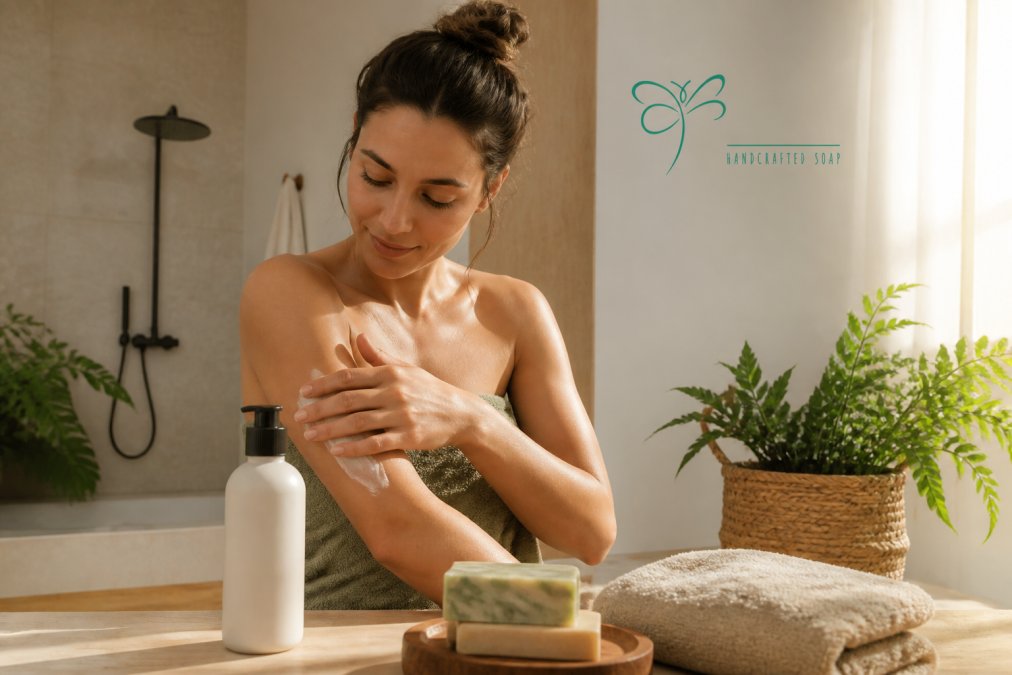
The Three-Minute Rule (The Part Most Guides Skip)
After you towel off, your skin is still slightly damp and warm, which increases absorption of whatever you put on it. Wait ten minutes and the surface water evaporates, taking some of your skin's own moisture with it, a process called transepidermal water loss.
The practical version:
- Turn off the water.
- Pat, do not rub. Rubbing with a towel creates friction that disrupts the barrier you just tried to protect.
- Apply moisturizer within three minutes, while skin still feels cool and slightly damp.
- Seal with an occlusive on the driest areas, elbows, shins, knees, if your lotion is water-based.
Adjust the Shower Itself
- Lower the water temperature to lukewarm, hot water dissolves skin lipids faster than warm water
- Cut shower time to under ten minutes
- Use a pH-balanced, fragrance-free wash
- Skip the loofah or washcloth on dry areas; hands or a soft silicone scrubber are gentler
- Keep the bathroom door closed so humidity stays in the room while you dry off
Why Winter Is Different, Mechanically
Cold outdoor air has low absolute humidity, and central heat warms that dry air further, dropping relative humidity, often below 30% in a heated home. Your skin equilibrates to that environment, losing water continuously. A body wash cannot fix that; it can only avoid making it worse. The moisturizer you apply in the first three minutes is what replaces the water your skin is losing all day.
A Winter Routine That Works With Your Body Wash
- Wash: butter-rich bar or cream wash, fragrance-free, lukewarm water
- Rinse: cool-ish final pass if you can tolerate it, it reduces the temperature gradient that drives evaporation
- Dry: pat, leave skin slightly damp
- Lock: humectant lotion, then an occlusive balm on the driest spots
- Maintain: reapply lotion to hands and shins once midday if you are in heated air all day
For a quick moisture boost after any shower, our Dew Drops melt into skin and are easy to use on the go.

How to Choose a Hydrating Body Wash: Cost Per Ounce and Water Quality
Two things most guides skip: cost per ounce and your water quality. Both change which hydrating body wash works for you.
- Check the price per ounce, not the sticker price
- Note whether your water leaves spots on glass (a hard-water sign)
- Choose a butter-rich bar if your water is hard
- Choose a lighter gel if your water is soft
Conclusion
Choosing a body wash that truly hydrates comes down to your skin type, a short list of proven ingredients, and a routine that locks moisture in. Get those three right and dry, tight skin becomes far less of a daily fight.
Frequently Asked Questions
What ingredients should I look for in a hydrating body wash?
Look for humectants like glycerin and hyaluronic acid that pull water into the skin, emollients like shea butter and cocoa butter that soften and smooth, and occlusives that lock moisture in. Ceramides and aloe vera also support the skin barrier. A hydrating body wash should list these near the top of the ingredient panel, not after synthetic dyes and fragrance. If you have dry skin, prioritize formulas built around moisturizers rather than thick lather.
What should I avoid in body wash if I have dry skin?
Skip sulfates, parabens, synthetic dyes, and heavy fragrance if your skin is dry or reactive. These can strip the lipid barrier and increase transepidermal water loss. Essential oils and strong surfactants may also trigger sensitivity. Fragrance-free formulas, like an unscented tallow and goat milk bar, are often the safest starting point. Check labels for sodium lauryl sulfate and synthetic fragrance near the top, which usually signals a harsher cleansing base.
How can I tell if a body wash is actually moisturizing?
Check whether the formula contains humectants, emollients, and occlusives, and whether it is pH-balanced and dermatologist-tested. A truly moisturizing body wash should leave skin feeling soft after patting dry, not tight or itchy. If your skin feels stripped within 10 minutes of showering, the cleanser is too harsh. Ingredients like glycerin, shea butter, and oatmeal signal real moisture retention rather than a temporary lather effect.
How often should I use a hydrating body wash to see results?
Daily use is fine if the formula is gentle and fragrance-free. Most people notice softer skin within one to two weeks of switching from a stripping cleanser. In winter, pair your hydrating body wash with a post-shower moisturizer applied within three minutes of toweling off to lock in water. If you have eczema or dermatitis, keep showers short and lukewarm, and avoid exfoliating scrubs during flare-ups.