

Table of Contents
- What Organic Oils Actually Do in Body Soap
- 7 Benefits of Organic Oils in Body Soap
- The Best Oils for Moisturizing Soap (and Why They Work)
- Natural Soap for Dry Skin: What to Look For
- Natural Soap for Sensitive Skin: Safety, Dilution, and Allergens
- Essential Oils vs. Fragrance Oils in Soap: Which Belongs in Your Bar?
- Conclusion: Choosing a Bar That Earns Its Place in Your Routine
- Frequently Asked Questions
Last Updated: October 12, 2026
What Organic Oils Actually Do in Body Soap
Organic oils in body soap are plant-derived fats and essential extracts grown and processed without synthetic pesticides or fertilizers, and they perform two distinct jobs: they form the soap itself, and they carry scent and skin benefits. At Minerva Rae, we build every bar around that split, because confusing the two roles is the single most common mistake we see in soap marketing.
Here is the part most guides skip. A bar of soap is not oil plus water. It is oil that has been chemically transformed through saponification, the reaction between a fat and lye that produces soap and glycerin. The oil you read on the label is no longer oil by the time you lather up. What survives is the fatty acid profile: whether the bar cleans gently or strips your skin, whether it lathers richly or fades fast, and whether it holds its shape in the shower.
That distinction matters more than the word "organic" on the wrapper.
Carrier Oils vs. Essential Oils: Clearing Up the Confusion
Carrier oils are the base fats that become the soap itself. Olive, coconut, canola, castor, and palm oils, plus butters like shea, cocoa, and sal, all fall into this category. They make up the bulk of any recipe and determine lather, hardness, and how moisturizing the bar feels.
Essential oils are volatile aromatic compounds distilled from plants. They appear in tiny amounts, usually measured in teaspoons per batch rather than cups, and they contribute scent and some therapeutic properties. They do not make soap. Drop a bottle of lavender essential oil into water and you have scented water, not a cleansing bar.
A useful rule: if an ingredient appears near the top of the list, it is structural. If it appears at the very end, it is likely there for fragrance or a minor benefit. The FDA guidance on cosmetic ingredient labeling requires ingredients to be listed in descending order of concentration, which makes this easy to check.
7 Benefits of Organic Oils in Body Soap
The benefits of organic oils in body soap come down to seven practical outcomes. Each one traces back to how a specific oil behaves once it becomes soap.
- Gentler cleansing. Oils high in oleic acid, like olive oil, produce a milder bar that removes dirt without over-stripping.
- Better moisture retention. Butters such as shea and sal leave a conditioning film that slows water loss after you towel off.
- Support for the moisture barrier. Fatty acids and natural glycerin help maintain the lipid layer that keeps skin comfortable.
- Softer, smoother skin. Regular use of a well-formulated bar reduces the tight, rough feeling that harsh cleansers leave behind.
- Fewer irritation triggers. Bars built on simple oil bases avoid some of the additives that sensitive skin reacts to.
- Natural antioxidants. Oils like olive and coconut carry vitamin E and related compounds that help protect against free radicals.
- Aromatherapy value. Essential oils in a warm shower release scent that many people find calming or energizing, supporting mood and relaxation.
None of these are magic. They are the predictable result of choosing oils whose properties match your skin.
The Best Oils for Moisturizing Soap (and Why They Work)
The best oils for moisturizing soap are olive oil, coconut oil, shea butter, cocoa butter, sal butter, and castor oil, each contributing something the others cannot.
Here is how the major soap-making oils compare on the properties that matter:
- Olive oil is roughly 55-85% oleic acid (a monounsaturated fat) and low in lauric and myristic acids, the fatty acids most responsible for aggressive cleansing. That profile produces a mild, low-lather bar with strong conditioning. A 100% olive oil bar (known as Castile) is famously gentle but slow to harden and can feel slimy until it cures for several months.
- Coconut oil is high in lauric and myristic acids, which is why it generates big, bubbly lather and a hard bar, and also why it can strip skin when it dominates a recipe. Most formulators cap it around 20-30% of the oil weight to keep the cleansing number in a comfortable range.
- Castor oil is rich in ricinoleic acid, a fatty acid that boosts lather stability and gives bars a dense, creamy bubble. It is usually used at 5-10% because too much makes a soft, sticky bar.
- Shea butter is high in stearic and oleic acids, contributing hardness and a skin-conditioning film. It also contains unsaponifiables, compounds that do not react with lye and remain in the bar to soften skin.
- Cocoa butter is very high in stearic acid, which makes a hard, long-lasting bar with a creamy rather than bubbly lather.
- Sal butter behaves similarly to shea, with a fatty acid profile that leans toward stearic and oleic acids and a melting point close to body temperature, so it feels rich without being greasy.
The mechanism behind all of this is saponification: when a fat meets lye (sodium hydroxide for bar soap), the triglyceride molecules split into fatty acid salts, the soap, and glycerin. The glycerin stays in a cold-process bar and acts as a humectant, drawing water toward the skin.
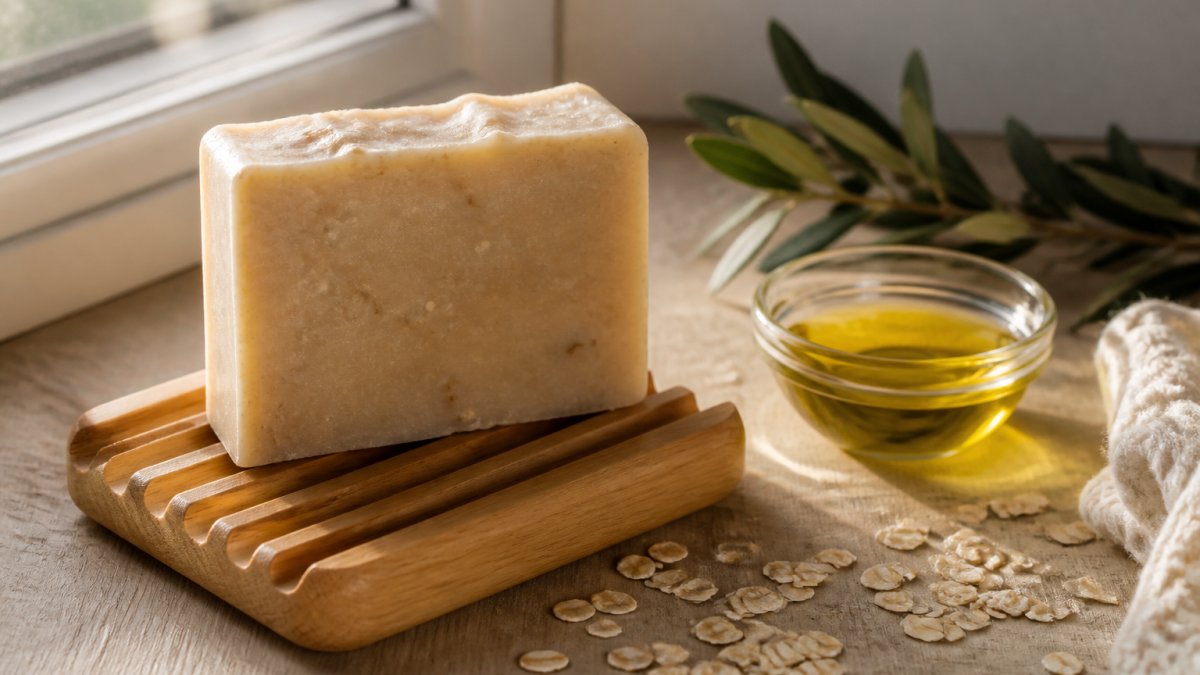
This is where soap-making chemistry earns its keep. A bar that is 100% coconut oil will clean aggressively and leave skin tight. The same bar with olive oil and a butter blended in becomes something you can use daily. Formulation is the whole game, and the fatty acid profile is the scoreboard.
Our Honeybee Artisan Soap shows the principle in practice: olive, coconut, and castor oils paired with sal butter, plus colloidal oatmeal and kaolin clay for a dense, cushioned lather that cleanses without stripping.

Natural Soap for Dry Skin: What to Look For
Natural soap for dry skin should lead with conditioning oils and butters, avoid high coconut oil content, and skip anything that promises "deep clean." Deep clean usually means stripping.
Look for these markers:
- Olive oil, shea butter, cocoa butter, or sal butter near the top of the ingredient list
- Glycerin retained in the bar rather than removed, which is typical of cold-process soap
- Colloidal oatmeal or kaolin clay for added slip and comfort
- No added fragrance if your skin is reactive
Our Cocoa Shea Artisan Soap was built for this exact need, combining African black soap and kaolin clay for gentle detox with shea butter, cocoa butter, and olive oil for triple-layer moisture. For skin that needs no scent at all, Tallow & Goat Milk is unscented and formulated for sensitive or dry skin, relying on tallow, goat milk, and olive oil for a smooth lather that cleanses without stripping.

Natural Soap for Sensitive Skin: Safety, Dilution, and Allergens
Natural soap for sensitive skin requires three things: a short ingredient list, correct dilution of any essential oils, and honest allergen labeling. "Natural" does not mean hypoallergenic.
Dilution is the part most guides skip. In cold-process soap, the lye reaction consumes a portion of the essential oil, but enough remains to trigger reactions in some people at higher concentrations.
Sensitization is different from irritation. Irritation is a direct reaction to a substance; sensitization is an immune response that develops after repeated exposure, meaning an oil you tolerated for months can suddenly cause a rash. Once sensitized, you may react to that oil, and sometimes to related oils, for years.
The American Contact Dermatitis Society allergen resources maintains lists of common fragrance allergens worth checking against any bar you are considering. The FDA guidance on cosmetic ingredient labeling requires ingredients to be listed in descending order of concentration, which helps you spot whether an essential oil appears near the top (a red flag for reactive skin) or at the very end.
If you are pregnant, breastfeeding, or shopping for young children, treat essential oils with extra caution. Many practitioners recommend avoiding or minimizing oils such as clove, rosemary, and wintergreen during pregnancy, and using only very low concentrations, or none at all, on infants and toddlers, whose skin is thinner and more permeable.
If your skin is reactive, start with an unscented bar and introduce scented options one at a time. Patch test on your inner forearm for a few days before using a new bar in the shower.
Essential Oils vs. Fragrance Oils in Soap: Which Belongs in Your Bar?
Essential oils and fragrance oils differ in origin, cost, and behavior in soap. Essential oils are distilled from plants and carry the plant's natural aromatic compounds. Fragrance oils are synthetic blends, sometimes with natural components, engineered to hold a specific scent. Neither is inherently better; they solve different problems.
| Factor | Essential Oils | Fragrance Oils |
|---|---|---|
| Origin | Plant distillation | Synthetic blend |
| Scent range | Limited to natural plants | Nearly unlimited |
| Behavior in soap | Can fade or shift | Stable and predictable |
| Allergen risk | Higher for some users | Depends on blend |
| Cost | Typically higher | Typically lower |
The practical answer: choose essential oils when you want aromatherapy value and are not sensitive to them. Choose fragrance oils when you want a specific scent that plants cannot provide, or when you need the scent to survive a long cure. Many artisan bars use a combination.
Conclusion: Choosing a Bar That Earns Its Place in Your Routine
The real challenge is not finding a soap with organic oils on the label. It is finding one whose formulation actually matches your skin, season after season, without irritation or that tight, stripped feeling. At Minerva Rae, we build each bar in small batches using cold process and melt and pour methods, with an intentionally curated line that pairs premium oils and butters with designs worth leaving on the counter. Explore the Collection to find the bar that fits your routine, whether that means a deeply moisturizing butter-rich formula or a pure, unscented bar for reactive skin.
Frequently Asked Questions
How do organic oils benefit body soap?
Organic oils do two jobs in a bar of soap. Oils like olive, coconut, and castor are the fats that saponify into the soap itself, so they determine how well it cleans without stripping skin. Others, such as shea butter and sal butter, stay behind as superfat, leaving a moisturizing layer on skin. Together they support moisture retention, skin softness, and the skin's natural moisture barrier, which is why organic oils matter more than the label suggests.
Can body soap with organic oils help dry skin?
Yes, when the formula is built for it. A natural soap for dry skin should lead with moisturizing oils such as olive, shea, or cocoa butter and skip harsh additives. Bars with colloidal oatmeal, kaolin clay, and butters like sal butter help skin feel comfortable after a shower rather than tight. If your skin is very dry, look for unscented options and follow with a body lotion while skin is still damp.
Is soap made with organic oils suitable for sensitive skin?
Often, but the oils are only part of the story. Fragrance, essential oils, and certain botanical additives cause most reactions, not the base oils. For sensitive skin, choose a short ingredient list, unscented bars, and patch test on your inner arm before full use. Avoid citrus and spice-heavy essential oils if your skin has reacted before. A plain tallow and goat milk bar is a common starting point.
How is an organic oil different from an essential oil in soap?
They serve different roles. Carrier oils such as olive, coconut, and castor are the base fats that become soap through saponification, and they determine how the bar cleans and moisturizes. Essential oils are concentrated plant extracts added in small amounts for scent and aromatherapy, not for lather or cleansing. In short: carrier oils build the bar, essential oils finish it. Confusing the two leads to unrealistic expectations about what a scented bar can do for skin.