

Table of Contents
- Why Custom Soap Labels Drive Brand Awareness
- Step 1: Define Your Brand Identity and Choose a Logo
- Step 2: Select Fonts and Typography for Readability
- Step 3: Create Soap Label Ideas That Reflect Your Brand
- Step 4: Write Compelling Soap Label Wording and Taglines
- Step 5: Choose Label Materials, Size, and Layout
- Step 6: Ensure Compliance and Include Required Information
- Step 7: Test Your Design and Gather Feedback
- Frequently Asked Questions
Last Updated: October 14, 2026
Why Custom Soap Labels Drive Brand Awareness
Your soap is beautiful. But if customers can't recognize it on a shelf, they'll reach for something else.
A well-designed label tells your brand story, protects your soap from water and wear, and makes people remember you.
Thoughtful label design can transform sales for handcrafted soap businesses. The labels that work aren't the fanciest, they're intentional and memorable.
This guide walks through seven steps to design custom soap labels that build brand awareness and turn first-time buyers into repeat customers.
Step 1: Define Your Brand Identity and Choose a Logo
Your brand identity is the foundation for every label choice: your brand name, core values, and the feeling you want customers to have, luxurious, natural, or playful.
Start with these questions:
- What makes your soap different from others?
- Who is your ideal customer?
- What emotion do you want them to feel when they hold your bar?
Once you've answered those, design or choose a logo. The simplest logos are the most memorable, a single symbol, your initials, or a clean geometric shape.
Your logo will appear on every label, so make sure it works at small sizes.
Step 2: Select Fonts and Typography for Readability
Customers need to read your soap name from arm's length. If they squint, your font is too small or too fancy.
Use these font guidelines:
- Brand name: One bold, distinctive font that stands out. Serif (traditional) or sans-serif (modern) both work, pick what matches your vibe.
- Body text: A clean, easy-to-read font for ingredient lists and instructions. Sans-serif fonts like Arial or Helvetica are safest.
- Limit yourself to two fonts maximum. One for the brand name, one for everything else. More than two fonts look chaotic.
Font size matters: your soap name should be at least 24 points, and your ingredient list never below 10 points.
Test your font choices by printing a sample label at actual size. Hold it at arm's length. Can you read it easily?
Step 3: Create Soap Label Ideas That Reflect Your Brand
Your label design should reflect what your soap is and who you are: premium for luxurious handcrafted soaps, organic and clean for natural-ingredient lines.
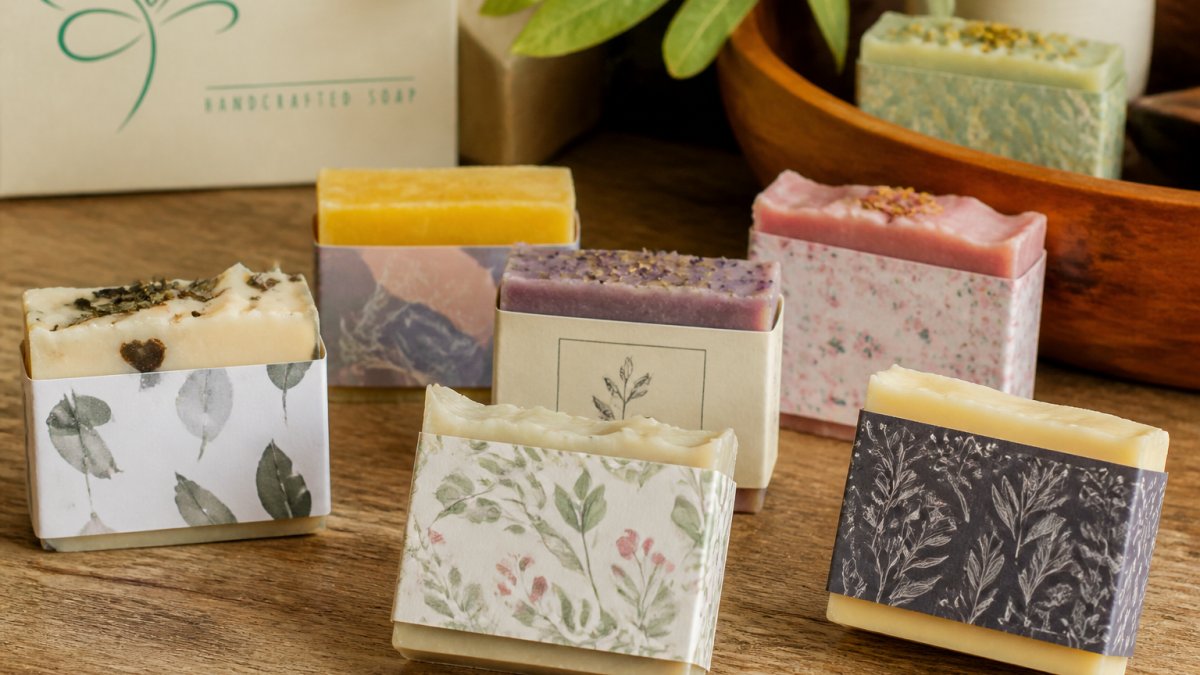
Consider these design elements:
- Minimalist and clean: A simple logo, one or two colors, lots of white space. Works for modern, upscale brands.
- Botanical and organic: Pressed flowers, leaf patterns, earthy colors. Works for natural, eco-conscious brands.
- Bold and colorful: Bright colors, patterns, playful fonts. Works for fun, energetic brands.
Don't copy competitors. Look at labels you love in other categories, wine, tea, cosmetics, food, and borrow the feeling, not the design.
Sketch three label concepts, then refine your favorite digitally using Canva (free), Adobe Illustrator, or a hired designer.
Step 4: Write Compelling Soap Label Wording and Taglines
Write these elements:
- Brand name: Clear and memorable. One or two words work best.
- Soap name: What is this specific bar called? "Lavender Dream," "Ocean Breeze," "Rose Garden", names that evoke the scent or feeling.
- Tagline: One sentence that captures your brand promise. Examples: "Handcrafted for your skin," "Pure ingredients, pure luxury," "Nature's gift to your daily ritual."
Keep wording simple and honest. "Handcrafted with love" resonates more than "artisanal small-batch formulation."
Step 5: Choose Label Materials, Size, and Layout
The material you choose affects how your label looks, how long it lasts, and your cost per unit. Treat it as a production decision, not just a design one.
Label Materials and Water Resistance
Your label will get wet, handled, and stored in a humid bathroom. Match the material to how the bar is used and sold.
- Kraft paper labels: Natural look, lowest cost, not water-resistant. Best for gift sets, boxes, or display bars that stay dry.
- Glossy paper stickers: Water-resistant coating, vibrant color, professional finish. Good for boxed bars and wrapped bars with light handling.
- Matte paper stickers: Softer look, easier to write on, less water-resistant than gloss. Good for premium boxed lines.
A quick rule: if the bar is sold unwrapped and used in the shower, choose a waterproof film. If the bar is boxed or given as a gift, paper stock is usually fine.
Test Labels Before You Commit
Designs that look great on screen can fail in real use. Run a small durability test before ordering a full run:
- Water test: Wet a labeled bar, let it sit for 10 minutes, then rub the label with your thumb. Watch for smearing, lifting edges, or color bleed.
- Oil test: Rub a drop of soap or oil across the label. Paper stocks often stain; vinyl and gloss films usually wipe clean.
- Heat test: Leave a labeled bar in a warm car or near a sunny window for a few hours. Adhesive can soften and edges can curl.
- Handling test: Pass the bar around to several people. Check whether corners lift or the surface scuffs.
- Adhesion test: Press the label onto the actual wrapper or box you plan to use. Some recycled and textured stocks resist adhesive.
If a label fails two or more tests, switch stock or add a protective laminate, which also guards against fading and scuffing.
Print Specifications That Matter
When you talk to a printer, these terms control cost and quality:
- Bleed: Extend background color about 0.125 inches past the trim line so no white edges show after cutting.
- Safe margin: Keep text and logos at least 0.125 to 0.25 inches inside the trim line.
- Resolution: Supply artwork at 300 DPI at final print size. Lower resolution looks blurry on small type.
Dimensions and Layout Spacing
- Wraparound label for a standard 4-ounce bar: roughly 3 inches wide by 2.5 inches tall.
- Box sticker: roughly 2 inches by 3 inches.
- Belly band for a 4-ounce bar: roughly 8 to 9 inches long by 1.5 to 2 inches tall, depending on bar circumference.
Always measure your actual packaging before designing. A label that fits one mold may not fit the next batch.

Layout spacing is just as important. Leave at least 0.25 inches of white space around all edges. Center your logo and brand name. Place your tagline and scent description below. Put ingredient lists and required information at the bottom. Use a grid or template to keep everything aligned.
DIY vs. Professional Printing
- DIY printing at home: Lowest upfront cost, best for testing and very small batches. Limited stock options, and home printers usually can't produce waterproof or laminated labels.
- Online label printers: Wide stock and finish selection, easy reordering, good for 100 to 1,000+ labels. Unit cost drops as quantity rises.
- Local print shops: Fast turnaround and hands-on proofing, but often higher per-unit cost for small runs.
Most makers start with DIY or a small online order to test the design, then move to a professional printer once it's proven. Ask about price breaks at 100, 250, 500, and 1,000 units, and factor in shipping and setup fees before comparing quotes.
Step 6: Ensure Compliance and Include Required Information
This is the step most makers rush, and the one that can force a reprint or trigger a regulatory problem. Rules depend on what your product is and where you sell it.
First, Know What Your Product Is
Soap labeling rules in the United States split into two main categories:
- True soap: Made primarily from fats and oils saponified with lye, and marketed only as soap. True soap is regulated by the Consumer Product Safety Commission (CPSC) under the Federal Hazardous Substances Act, not as a cosmetic (Soap Business Guidance).
- Cosmetic soap: If the product makes cosmetic claims (moisturizes, cleans, beautifies, deodorizes) or contains synthetic detergents, it is regulated by the FDA as a cosmetic.
- Drug claims: If the label claims to treat or prevent a condition (for example, "treats acne" or "kills bacteria"), the product is regulated as a drug and needs far more than a label change.
Many handcrafted soap makers describe skin benefits, so cosmetic labeling rules often apply.
Required Information Checklist
For a cosmetic soap, the label generally needs:
- Product name: The name of the soap.
- Net quantity of contents: Weight or volume in both metric and U.S. customary units, placed on the principal display panel.
- Ingredient declaration: Listed in descending order of predominance by weight, using INCI names. Ingredients present at 1% or less may be listed in any order after the higher-concentration ingredients. Colorants may be listed as "may contain" followed by the colorants.
For true soap under CPSC rules, requirements differ. Hazardous substances need cautionary labeling under the Federal Hazardous Substances Act; non-hazardous soap has lighter requirements, though net weight and business identity remain standard practice and are often required by retailers.
Claims You Should Avoid
Label claims are where most problems start. Avoid:
- Drug claims: "Heals," "cures," "treats," "repairs," "kills bacteria," or any statement that implies a medical effect.
- Unsupported cosmetic claims: "All natural," "chemical-free," "hypoallergenic," or "dermatologist tested" if you can't substantiate them.
- Misleading ingredient claims: "Made with organic lavender" when only a trace is organic.
Safer wording: "made for sensitive skin," "nourishes dry skin," "crafted with shea butter." These describe the product without promising a medical outcome.
State and Retailer Requirements
Federal rules are the floor, not the ceiling. Some states add labeling or registration requirements for cosmetics and soaps sold within their borders. If you sell at farmers markets, craft fairs, or wholesale, ask each venue and buyer what they require, many retailers also want a batch or lot code, best-by date, and UPC or barcode.
Build a Compliance File
Keep a simple folder with:
- Your current label artwork and version date.
- Ingredient lists with INCI names and percentages.
- Supplier certificates and safety data sheets.
This file protects you if a retailer, distributor, or regulator asks questions, and speeds up future label updates.
Step 7: Test Your Design and Gather Feedback
Before you print 500 labels, test your design with real people.
Ask specific questions:
- Does the brand name stand out?
- Can you read all the text easily?
- Does the design match what you expected?
Pay attention to feedback about readability and appeal, and ignore pure personal preference.
Once you're satisfied, order your full batch. Most printers offer bulk discounts at 100, 250, or 500+ quantities.
Designing custom soap labels is one of the most direct ways to build brand recognition and stand out in a crowded market.
At Minerva Rae, we understand your label is often the first touchpoint between your soap and a customer. We offer premium packaging like Rustic Kraft Pillow Boxes starting at $55.00 for 25 bars, featuring our signature apothecary-style presentation with hand-tied natural twine.

Start with a clear brand identity. Choose readable fonts. Design with intention. Test with real people.
Frequently Asked Questions
What information must I include on a homemade soap label?
Your label must include the product name, net weight, ingredient list (in descending order by weight), your business name and address, and any required warning statements. The FDA regulates cosmetic labeling, so if your soap makes any skincare claims beyond cleansing, it may be classified as a drug and require additional disclosures. For handmade soaps sold as cosmetics, listing all ingredients clearly builds trust and ensures compliance with labeling regulations.
How do custom soap labels with logo help build brand recognition?
A consistent logo and color palette across your custom soap labels create visual identity that customers recognize on shelves and remember when shopping. When your logo appears on every bar, packaging, and marketing material, it reinforces brand awareness each time someone uses your soap or sees it in a store. This consistency is especially powerful for wholesale orders, wedding favors, and corporate gifting, where a professional label signals quality and intentionality.
What's the best soap label size for wraps versus boxes?
Belly band wraps typically work best at 2 inches by 4 inches to 2.5 inches by 5 inches, depending on your bar size. Front-and-back box labels are usually 3 inches by 4 inches or larger. Measure your actual soap bars first, then leave 0.25 inches of clearance on all sides to account for wrapping and printing variations. Test your label size on a sample bar before ordering bulk quantities to ensure text is legible and your design doesn't feel cramped.
Should I use templates or create a custom design for my soap labels?
Templates offer speed and affordability for starting out, but custom designs build stronger brand awareness because they reflect your unique identity. If you're selling handcrafted soaps as a business or offering custom orders for events, a distinctive design, even a simple one, signals professionalism and justifies premium pricing. Consider starting with a template while you refine your brand, then invest in custom design once you've identified your core colors, fonts, and visual style.