

Table of Contents
- Understanding Cold Process Soap for Sensitive Skin
- Best Oils for Sensitive Skin Soap Formulations
- Cold Process Oatmeal Soap Recipe for Gentle Cleansing
- Soap Recipe for Sensitive Skin Without Essential Oils
- Cold Process Soap Curing Time and Quality Checks
- Recommended Minerva Rae Recipes Ready to Use
- Common Mistakes to Avoid When Making Sensitive Skin Soap
- Frequently Asked Questions
Last Updated: October 6, 2026
Understanding Cold Process Soap for Sensitive Skin
Cold process soap recipes for sensitive skin require careful ingredient selection and understanding of how saponification works. At Minerva Rae, we create handcrafted soaps using cold process methods to deliver gentle, nourishing bars that respect delicate skin. Unlike mass-produced soaps that rely on harsh detergents and synthetic fillers, cold process soap preserves natural glycerin and allows you to control every ingredient that touches your skin.
The cold process method involves mixing oils with sodium hydroxide (lye) at lower temperatures. This slower saponification process creates a milder, more moisturizing bar. For sensitive skin, this matters because the gentle saponification preserves the skin's natural pH balance and doesn't strip away protective oils.
When formulating cold process soap recipes for sensitive skin, you're not just choosing ingredients, you're building a foundation for skin comfort. The oils you select, their ratios, and how they interact during saponification determine whether your finished bar will soothe or irritate.
Best Oils for Sensitive Skin Soap Formulations
The right oil combination is the backbone of any cold process soap recipes for sensitive skin. Certain oils create a creamy lather that cleanses without stripping, while others add nourishment and stability to the bar.
Olive oil is the workhorse for sensitive skin formulations. It's high in oleic acid, which penetrates the skin gently and provides deep moisture. It creates a mild, creamy lather and is well-tolerated by even reactive skin types.
Castor oil adds thickness and stability to your lather. Castor oil is also naturally soothing, making it ideal for sensitive skin applications.
Coconut oil provides cleansing power, but use it sparingly in sensitive skin recipes. Too much coconut oil can be drying, but the right amount creates a pleasant lather without irritation.
Shea butter brings luxury and nourishment. Shea butter adds conditioning properties and helps the bar feel creamy in the shower. It's particularly beneficial for dry, sensitive skin.
Tallow (rendered beef fat) creates a hard, long-lasting bar that many people find incredibly gentle. Tallow contains natural fatty acids similar to skin's sebum, making it exceptionally soothing.
Avocado oil, though less common, offers deep moisture and is well-tolerated by sensitive skin.
| Oil | Percentage Range | Key Benefit | Best For |
|---|---|---|---|
| Olive Oil | 30-50% | Gentle moisture | All sensitive skin types |
| Castor Oil | 5-10% | Lather boost | Creamy bar texture |
| Coconut Oil | 15-25% | Cleansing | Balanced formulas |
| Shea Butter | 5-10% | Conditioning | Dry, sensitive skin |
| Tallow | 20-30% | Long-lasting bar | Traditional, soothing bars |
| Avocado Oil | 5-10% | Deep nourishment | Extra-sensitive skin |
Cold Process Oatmeal Soap Recipe for Gentle Cleansing
Oatmeal is one of the most soothing additives for sensitive skin. Colloidal oatmeal (finely ground oat kernel flour) dissolves into your soap batter and creates a gentle exfoliant that doesn't scratch or irritate. A cold process oatmeal soap recipe for gentle cleansing combines mild oils with this skin-calming botanical.
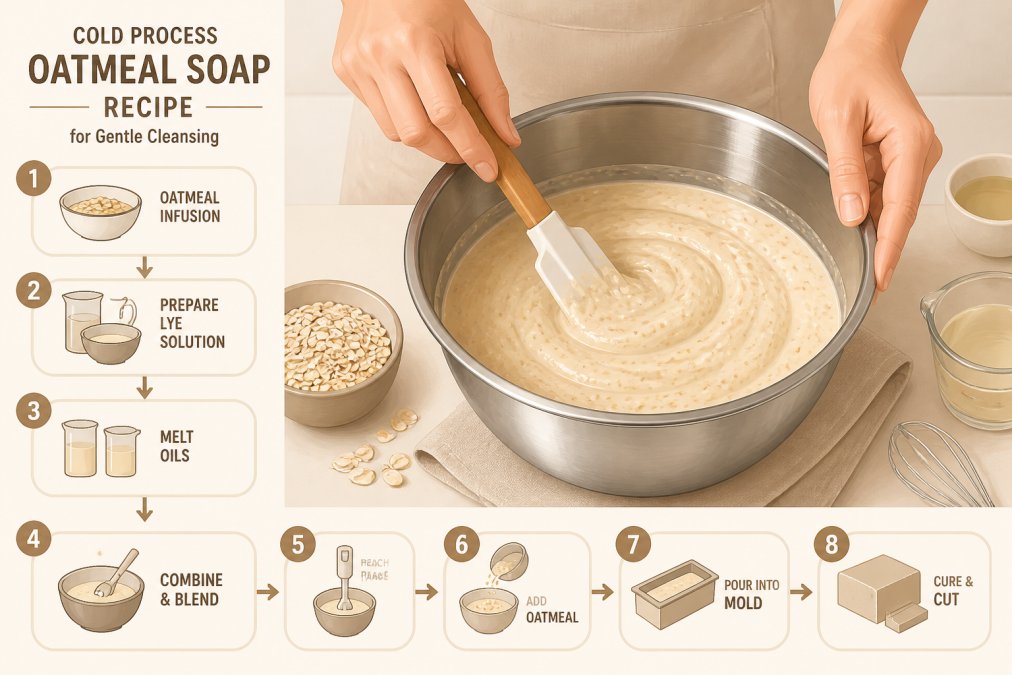
Basic Cold Process Oatmeal Recipe for Sensitive Skin
Oils (total 32 oz):
- Olive oil: 16 oz (50%)
- Coconut oil: 6 oz (19%)
- Shea butter: 3 oz (9%)
- Castor oil: 3 oz (9%)
- Tallow: 4 oz (13%)
Lye Solution:
- Sodium hydroxide: 4.5 oz
- Distilled water: 10 oz
Additives (added at light trace):
- Colloidal oatmeal: 2 tablespoons
- Honey: 1 tablespoon (optional, adds moisture)
- Essential oil (optional): 0.5 oz lavender or chamomile for fragrance-sensitive skin
Instructions:
-
Weigh all oils precisely using a digital scale. Mix them in a stainless steel pot and heat to 100-110°F.
-
In a separate heat-safe container, slowly add sodium hydroxide to distilled water (never water to lye). Stir until dissolved. Let cool to 100-110°F.
-
When both reach target temperature, slowly pour lye solution into oils while stirring continuously for 5-10 minutes.
-
Continue stirring until the mixture reaches "light trace", when a drizzle across the surface briefly holds its shape before sinking back in.
-
Add colloidal oatmeal and honey, stirring gently to distribute evenly.
-
If using essential oil, add now and stir well.
-
Pour into a lined mold and cover loosely with plastic wrap. Let sit undisturbed for 24 hours.
-
Unmold, cut into bars, and cure for 4-6 weeks before use.
This recipe creates approximately 2.5 pounds of soap, yielding about 8-10 bars depending on size.
Soap Recipe for Sensitive Skin Without Essential Oils
Many people with sensitive skin react to fragrance, both natural essential oils and synthetic fragrance oils. A cold process soap recipe for sensitive skin without essential oils addresses this concern directly. Unscented soap is often the safest choice for reactive or compromised skin barriers.
Fragrance-Free Sensitive Skin Recipe
Oils (total 32 oz):
- Olive oil: 15 oz (47%)
- Coconut oil: 7 oz (22%)
- Shea butter: 4 oz (12%)
- Castor oil: 3 oz (9%)
- Tallow: 3 oz (10%)
Lye Solution:
- Sodium hydroxide: 4.6 oz
- Distilled water: 10 oz
Additives (at light trace):
- Colloidal oatmeal: 1.5 tablespoons (optional)
- Goat milk powder: 1 tablespoon (adds creaminess and moisture)
Instructions follow the same method as the oatmeal recipe. The key difference is the absence of fragrance. Goat milk powder adds a subtle sweetness and natural creaminess without fragrance chemicals.
For people with fragrance sensitivities, this unscented bar is often more tolerable than even "natural" essential oil versions. The goat milk provides gentle nourishment that many find soothing for reactive skin.
Minerva Rae's Tallow & Goat Milk soap ($12.00) follows this principle, it's handcrafted without added fragrance, allowing the pure, nourishing ingredients to speak for themselves. This approach appeals to people who've experienced irritation from scented products.

Cold Process Soap Curing Time and Quality Checks
The curing phase is where cold process soap recipes for sensitive skin reach their full potential. During cure, water evaporates from the bars, making them harder, longer-lasting, and gentler on skin. Rushing this step compromises your finished product.
A minimum 4-week cure is standard for cold process soap. For sensitive skin formulations, many soapmakers extend this to 5-6 weeks to ensure complete saponification and optimal mildness.
Quality checks during curing:
Check the pH of your cured bars using pH strips or a digital pH meter. Properly cured cold process soap should measure between 8.5 and 10 on the pH scale. If your bar reads above 10, it contains unreacted lye and isn't safe for skin.
Perform a simple zap test: touch your tongue to the bar. A properly cured bar produces no tingling or unpleasant sensation. A zap (tingling on your tongue) indicates unreacted lye, the bar needs more curing time.
Assess hardness by pressing your thumbnail into the bar. A well-cured bar resists indentation. If your thumb sinks in easily, the bar needs additional cure time.
Examine the surface for white powder (soda ash). While cosmetically undesirable, soda ash doesn't affect the bar's performance or safety. It's purely aesthetic.
Store curing bars in a cool, dry place with good air circulation. Proper curing conditions produce a harder, longer-lasting bar that's gentler on sensitive skin over time.
Recommended Minerva Rae Recipes Ready to Use
For those who prefer the certainty of professionally formulated bars, Minerva Rae's handcrafted cold process soaps for sensitive skin offer tested formulations without the learning curve of making your own.
The Old Fashioned Tallow & Oatmeal Artisan Soap ($12.00) combines the traditional gentleness of tallow with soothing oatmeal. This bar delivers light exfoliation and a creamy lather that respects sensitive skin. The formulation uses tallow, coconut oil, shea butter, and olive oil, the same oils recommended for homemade sensitive skin recipes.

For those avoiding fragrance entirely, Minerva Rae's Tallow & Goat Milk ($12.00) is unscented and formulated specifically for sensitive or dry skin. The combination of nourishing tallow and soothing goat milk creates a smooth lather without stripping.
The Honeybee Artisan Soap ($12.00) offers a middle ground for sensitive skin that tolerates gentle scents. Made with olive, coconut, and castor oils plus sal butter, it includes colloidal oatmeal and kaolin clay for a silky, soothing experience. The honey and natural ingredients create a dense lather that's conditioning without irritation.

For a lightly scented option, the Bulgarian Lavender ($12.00) uses pure Bulgarian lavender essential oil, known for its calming properties, combined with colloidal oats, shea butter, and olive oil. The purple clay adds gentle color without synthetic dyes.
Each bar is approximately 4.5 oz and handcrafted using cold process methods. These ready-made options eliminate guesswork while delivering the same gentle, nourishing approach as homemade cold process soap recipes for sensitive skin.
Common Mistakes to Avoid When Making Sensitive Skin Soap
The most common error in sensitive skin soap formulation is using too much coconut oil. While coconut oil creates a nice lather, high percentages (above 30%) can be drying and irritating.
Skipping the curing phase is another frequent mistake. Impatience leads people to use soap before saponification completes, resulting in bars that feel harsh or cause irritation. The 4-6 week cure isn't optional, it's essential for safe, gentle soap.
Adding fragrance too early in the soap-making process can cause acceleration or separation. Always add fragrance at light trace, never during the initial lye-oil mixing phase.
Overheating your oils and lye solution creates a soap that's more difficult to work with and can become grainy or crumbly. Keep temperatures between 100-110°F for best results.
Using tap water instead of distilled water introduces minerals that can interfere with saponification and create soap that doesn't lather well. Always use distilled water for your lye solution.
Neglecting to weigh ingredients precisely is a recipe for disaster. Cold process soapmaking requires exact measurements. A digital scale accurate to 0.1 oz is essential, volume measurements won't work.
Not researching individual ingredient sensitivities is another pitfall. Some people react to specific oils or botanicals even though they're generally considered gentle. When making soap for someone with sensitive skin, ask about their known triggers first.
Using essential oils in concentrations above 0.5 oz per pound of oils can irritate sensitive skin.
Making cold process soap recipes for sensitive skin rewards careful attention to ingredients, temperatures, and timing. Whether you're crafting your own bars or choosing handcrafted options from Minerva Rae, the principles remain the same: quality oils, proper saponification, complete curing, and fragrance consideration. Sensitive skin deserves soap formulated with intention.
Frequently Asked Questions
What is the cold process method for making soap?
Cold process soapmaking mixes oils and sodium hydroxide (lye) at room temperature, allowing the saponification reaction to occur naturally over time. The soap cures slowly for 4-6 weeks. This method produces dense, long-lasting bars ideal for sensitive skin because the gentle reaction allows you to control every ingredient without heat degradation.
Can fragrance-free cold process soap be better for sensitive skin?
Yes. Fragrance-free cold process soap eliminates potential irritants from essential oils and fragrance compounds, making it ideal if your skin reacts to scents. Products like Tallow & Goat Milk ($12.00) are unscented and formulated specifically for sensitive skin, delivering a clean lather without added fragrance. If you prefer subtle scent, always patch-test first.
How long does cold process soap need to cure before use?
Cold process soap requires 4-6 weeks of curing to complete saponification and harden properly. During this time, the bar loses moisture, becomes more durable, and lasts longer in use. Store bars in a cool, dry place with air circulation during curing. Rushing this step compromises both safety and bar longevity.
Which oils make the gentlest cold process soap for sensitive skin?
Olive oil, castor oil, avocado oil, and tallow provide gentle, nourishing bases for sensitive skin soap. Olive oil delivers moisture and a stable lather; castor oil adds conditioning and bubble structure; tallow (rendered beef fat) is deeply nourishing and mimics skin's natural lipids. Shea butter and goat milk enhance creaminess and soothing properties. Avoid high coconut oil percentages (over 30%) as it can be drying. Minerva Rae's formulations balance these oils to create bars that cleanse without stripping.
What additives soothe sensitive skin in cold process soap?
Colloidal oatmeal, white clay, rose clay, and honey are skin-safe additives that calm irritation without irritating further. Oatmeal provides gentle exfoliation and soothing properties; clays offer mild cleansing and silkiness; honey adds moisture. The Old Fashioned Tallow & Oatmeal bar ($12.00) combines oatmeal with tallow and shea butter for proven sensitive-skin comfort.